
Telehealth vendors handling protected health information (PHI) on behalf of healthcare providers must meet applicable HIPAA requirements. But compliance alone may not be enough to win hospital contracts. Hospitals also need proof that your platform protects patient data.
HHS does not certify software as HIPAA compliant. That’s why hospital security teams look beyond compliance claims. They typically ask for a signed Business Associate Agreement (BAA), a SOC 2 Type II report, and clear answers about patient recordings, AI tools and third-party data sharing.
This guide explains HIPAA compliance requirements for telehealth vendors, how SOC 2 Type II supports them, and what hospitals expect beyond both.
What Is Healthcare Compliance for Telehealth?
Healthcare compliance for telehealth covers the laws, contracts and audits that control how your platform handles patient data.
For vendors selling to hospitals, it has three layers.
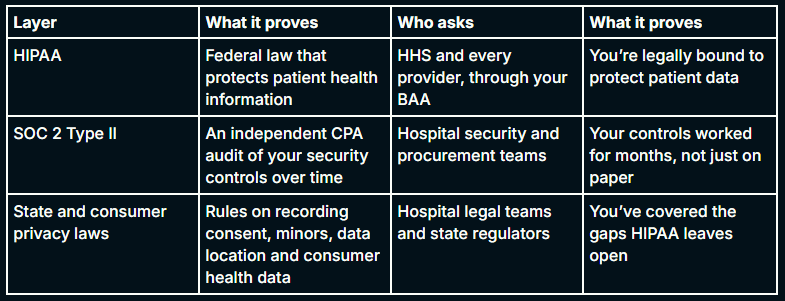
HIPAA and SOC 2 overlap a lot. They still answer different questions.
- HIPAA asks, are you legally protecting patient data?
- SOC 2 asks, can you prove your controls work?
Hospitals want a yes to both. So why do telehealth vendors face a higher bar than other healthcare software? It comes down to how the business works.
Why Telehealth Vendors Need Stronger Compliance Support
Your business model builds up risk faster than most healthcare SaaS. Here are the six reasons hospitals look harder at you.
1. Your Buyers Run Tough Security Reviews
Hospitals have lived through years of ransomware and supplier breaches. Your platform plugs into their clinical workflow, their EHR and their patients’ phones.
So, they treat you as high risk. Clinicians can love your demo while the security review drags on for months. Compliance often decides when the deal closes.
2. You Touch Patient Data at Every Step of a Visit
Most healthcare software stores records. Your platform creates them live.
Think about one visit:
- Video, audio and chat
- Intake forms and device readings
- Recordings, transcripts and AI notes
Each one is a place where data can leak. Hospitals will ask about all of them.
3. Your Patients and Clinicians Live in Different States
A clinician in North Carolina can treat a patient in California. That one call can bring in California’s recording consent law. It can also bring in another state’s rules on teen privacy and the hospital’s own data location terms.
4. You Might Run Two Businesses in One Product
Many telehealth companies sell to hospitals and also run a consumer app.
- The hospital side falls under HIPAA.
- The consumer side may not. It can fall under FTC Health Breach Notification Rule and state laws like Washington’s My Health My Data Act.
Mix those two data sets without clear walls, and you create risk on both sides.
5. Your Supplier List Is Long
Video SDKs, cloud hosting, transcription, error tracking, analytics and support tools can all touch patient data. You’re responsible for each of them under HIPAA. Hospitals expect you to name every one and show a signed BAA.
6. You Ship Fast, Often With AI
AI scribes, symptom checkers and visit summaries are now standard features in telehealth. Each one changes where patient data goes. Each AI supplier also needs a BAA. A risk analysis from last year rarely covers what you shipped last quarter. Hospital reviewers look for exactly that gap.
I think vendors who treat compliance as a rush job before a big deal usually lose months on that deal. The ones who close faster treat it like part of the product. That means a named owner, a roadmap and evidence collected from day one.
It all starts with HIPAA.
HIPAA Compliance for Telehealth Vendors: What the Law Requires
HIPAA asks telehealth vendors to follow three rules: Privacy, Security and Breach Notification. You also sign a business associate agreement (BAA) with every provider you serve.
Here’s what that looks like on a telehealth platform.
Does HIPAA Apply to Telehealth Vendors?
Yes, in most cases. If your product creates, receives, stores or sends patient data for a provider, HIPAA calls you a business associate.
That includes:
- Video visit platforms
- Remote patient monitoring and connected device companies
- Online visit and patient messaging apps
- Online prescribing, scheduling and intake tools
- AI scribes and clinical documentation tools
- Telehealth APIs built into EHRs
HIPAA has one narrow exception. It covers “conduits” that only pass data along, like an internet provider. So, most telehealth platforms don’t qualify. They store recordings, chat logs, notes or device readings.
The Three HIPAA Rules, in Plain Terms
Privacy Rule: What you may do with patient data.
- Use data only for the services your BAA allows.
- Collect only what each feature needs.
- Be ready to export or correct a record when the hospital asks.
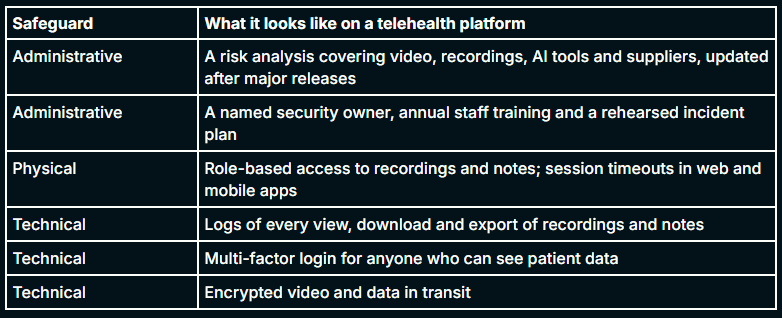
Security Rule: How you protect patient data. It covers every system that holds patient data, not just your main database.
Breach Notification Rule: What do you do when something goes wrong.
- HIPAA gives business associates up to 60 days to report a breach.
- Your BAA usually sets a much shorter deadline. Plan around the BAA.
Start with the risk analysis. It shapes every other safeguard. It’s also the requirement HHS cites most often in its investigations. For the full list, see our digital health HIPAA compliance guide.
Does HIPAA Require Encryption for Telehealth Video?
HIPAA calls encryption “addressable.” You must encrypt unless you can document why it doesn’t fit and use something just as strong. For live videos, that case rarely holds up.
HHS has proposed making encryption mandatory. That update now targets final action in July 2027. Hospitals already treat it as mandatory.
Encryption protects you after an incident too. If stolen data was properly encrypted and the key stayed safe, it isn’t a reportable breach.
Hospitals will also ask where you decrypt video.
- On most platforms, your servers can see the stream. You need that for recording, transcripts, and AI notes.
- End-to-end encryption hides the stream from you. You usually lose those features.
Pick your approach and write down why.
How to Handle Session Recordings?
Treat every recording as patient data. Here’s the baseline:
- Record only when the provider turns recording on.
- Limit access to named roles.
- Log every view and download.
- Delete on the schedule your BAA sets.
Two details often slip through.
Copies: Deletion must cover backups, transcripts, AI notes and files sent to transcription services. The video alone isn’t enough.
Consent: California, Florida, Maryland and Washington are among the states that need every participant’s consent to record. Calls cross state lines, so ask everyone, every time. Log each consent with the session record.
Only need the final clinical note? Delete the recording. Keeping it adds risk and no value.
Which BAAs Does a Telehealth Vendor Need?
You need a BAA with each hospital. You also need one with every supplier that can touch patient data:
- Video and communication providers
- Cloud hosting and databases
- AI transcription and note taking services
- Logging, error tracking and analytics tools
Either sign a BAA or strip patient data before it reaches them. Tracking scripts behind a patient login carry the same risk.
For AI suppliers, your contract should limit use, retention and model training. Read our AI BAA compliance guide and do AI scribes need a BAA.
HIPAA sets the rules. It doesn’t give you a certificate to show buyers. That’s where SOC 2 Type II comes in.
Is your telehealth platform ready for a security review? KLEAP’s HIPAA and SOC 2 gap assessment shows you what to fix before your audit starts.
SOC 2 Type II for Telehealth: How You Prove Your Controls Work
SOC 2 Type II is an independent CPA audit. It tests whether your security controls worked every day over 3 to 12 months. Hospitals use it as proof of your HIPAA safeguards. HHS doesn’t certify any software as HIPAA compliant.
A “HIPAA compliant” badge on your website won’t get you through review. A clean SOC 2 Type II report usually will.
Why Hospitals Want Type II, Not Type I
- Type I shows your controls are designed well on one date.
- Type II shows they ran every day across the audit period.
Some hospitals accept Type I for a small pilot, especially if your Type II period is underway. Plan on Type II for a full contract.
Timing trips up most vendors. If you start SOC 2 when a hospital asks, you’re already months behind.
What SOC 2 Auditors Test on a Telehealth Platform
Auditors pull a list of every time a control should have run. They pick a sample and check the evidence for each. Say five people left your company. The auditor checks that each one lost access on time.
On a telehealth platform, expect the same testing for:
- MFA on every account that can see patient data
- Session links that expire and waiting rooms that block uninvited guests
- Regular reviews of who can access recordings and notes
- Log reviews, backup restore tests and security training
- Fixes for pentest findings, including your AI features
Three rules keep your report clean:
- Run every control from day one. A control started halfway can’t cover the full period.
- Date and save your evidence. No record means the control didn’t run.
- Expect hospitals to read your exceptions closely. Every missed control shows up there.
Want the full control mapping? See our SOC 2 vs HIPAA guide.
For the healthcare audit process, read our SOC 2 Type II guide for healthcare.
What If Your SOC 2 Report Is Getting Old?
Hospitals usually want a report whose audit period ended in the last 12 months. For short gaps, your management can sign a bridge letter. It confirms nothing major changed and no incidents happened since the audit period ended.
Plan your audit cycle so a current report is always ready. A current report gets you into the review. For telehealth, it rarely closes it.
Telehealth Compliance Beyond HIPAA and SOC 2: What Hospitals Still Ask
Hospitals ask about risks a standard SOC 2 report doesn’t cover. Most of these questions show up in a security questionnaire. Have the below answers ready before the review starts.
Where Does Patient Data Go?
Keep a data flow diagram that follows patient data from first contact to deletion. It should show:
- Where data comes in
- How it moves between services
- Where you store it
- Extra copies in error logs, support tickets, analytics and AI tools
- When and how you delete it
Test it with a fake consultation. Then search your systems for the test patient’s details.
Check test environments too. Developers sometimes copy real records there to fix bugs. Use fake or anonymized data instead.
What Does Your AI Record?
A voice can identify a patient even when the transcript drops the name. Hospitals will ask:
- What you record and how long you keep it
- Who else is on the call, like family or interpreters
- Which AI companies receive the audio, and whether they train on it
- Whether you’ve tested your AI for prompt injection
Standard pentests often miss that last one.
Can Offshore Teams See Patient Data?
HIPAA doesn’t ban offshore access in general. Hospital contracts and state rules can.
- Some Texas Medicaid contracts limit offshore access.
- Florida limits where certain providers can store electronic patient records.
Know which staff and suppliers can see patient data, and from which countries.
Does Your Mobile App Protect Patients on Shared Phones?
Hospitals check that:
- Notifications stay generic, like “You have a new message”
- Local data gets cleared or locked after logout
- The app switcher hides patient screens
- Idle sessions time out
How Do You Handle Caregivers and Minors?
Give parents and caregivers their own accounts. Shared logins hide who opened a record. Some states let teens get certain mental health, sexual health or substance use care without a parent’s consent. Your platform must block parent access where the law requires it.
All of this sounds like a lot. One tightly scoped program can cover it.
How Telehealth Vendors Can Build One Compliance Program for HIPAA and SOC 2 Type II
Scope one program around patient data. Then let HIPAA and SOC 2 share the same controls and evidence.
Here’s the order we recommend for telehealth vendors:
- Map your patient data. List every system, supplier and copy. This sets your HIPAA and SOC 2 scope at once.
- Run a HIPAA risk analysis on that map. Cover video, recordings, AI tools and suppliers.
- Fix the big gaps and sign your BAAs. Do this before the audit clock starts.
- Start your SOC 2 Type II audit period. Run every control from day one and save dated evidence.
- Build a hospital answer pack. Include your data flow diagram, risk analysis summary, BAA list, pentest results and AI testing.
Follow this order, and your SOC 2 evidence also proves your HIPAA safeguards. Nothing gets built twice.
How KLEAP Helps Telehealth Vendors Get Audit-Ready
KLEAP takes telehealth vendors from a first gap assessment to a SOC 2 Type II report hospitals accept. Every client gets one dedicated lead.
We build only what your buyers and regulators ask for.
- SOC 2 and HIPAA gap assessment: We check your platform against SOC 2 and the HIPAA Security Rule. You get a ranked fix list before your audit starts.
- SOC 2 implementation: We write policies around how your team really works. We also set up the processes that produce the evidence auditors sample.
- Manual penetration testing: We test web, mobile, API, cloud and AI. We confirm every finding by hand, so hospitals see real risk, not scanner noise.
- Ongoing advisory: Virtual CISO support, HIPAA risk analysis and risk assessments keep your controls running between audits.
Talk to us about SOC 2 Type II and HIPAA for your telehealth platform.
Frequently Asked Question
Is there a HIPAA certification for telehealth software?
No. HHS doesn’t certify any software as HIPAA compliant. A “HIPAA certified” badge from a third party is a training or assessment certificate, not government approval. Hospitals look for a SOC 2 Type II report instead.
Do telehealth vendors need a HIPAA risk assessment?
Yes. The Security Rule requires every business associate to run a risk analysis and keep a plan to reduce the risks it finds. Hospitals often ask for your latest one. Update it whenever you add a major feature, such as AI scribing or a new video provider.
Is my platform HIPAA compliant if my video provider signs a BAA?
No. Their BAA covers only the part of the service they run. Your storage, recordings, logs, AI tools, access controls and support processes are still your responsibility.
Are Zoom, Google Meet and Microsoft Teams HIPAA compliant for telehealth?
Each can be, on the right plan with a signed BAA and correct settings. Zoom’s free, Basic and standard Pro plans without the healthcare add-on don’t qualify. Google covers Meet under its Workspace BAA. Microsoft includes its BAA in its standard terms for eligible customers, but it doesn’t cover third-party apps connected to Teams. If you embed any of these, confirm the BAA covers the exact product you use, since video SDKs often have different terms.
Does an internet provider or CDN need a BAA for telehealth?
Usually not. HIPAA’s conduit exception covers services that only transmit data, like an ISP. A CDN or relay that caches, records or can inspect media falls outside it and needs a BAA.
Can a telehealth vendor start a hospital pilot with SOC 2 Type I?
Often, yes. A Type I report shows your controls are designed correctly on one date, and many hospitals accept it for a limited pilot, especially if your Type II audit period is underway. Expect to need Type II for a full contract.
Do hospitals require HITRUST instead of SOC 2?
Some large health systems prefer HITRUST, and a few require it. Most accept SOC 2 Type II. Ask your target hospitals first, because HITRUST takes longer and costs more.
How long is a SOC 2 report valid?
It has no formal expiry date. In practice, hospitals expect a report whose audit period ended within the last 12 months. A bridge letter covers the gap between reports.