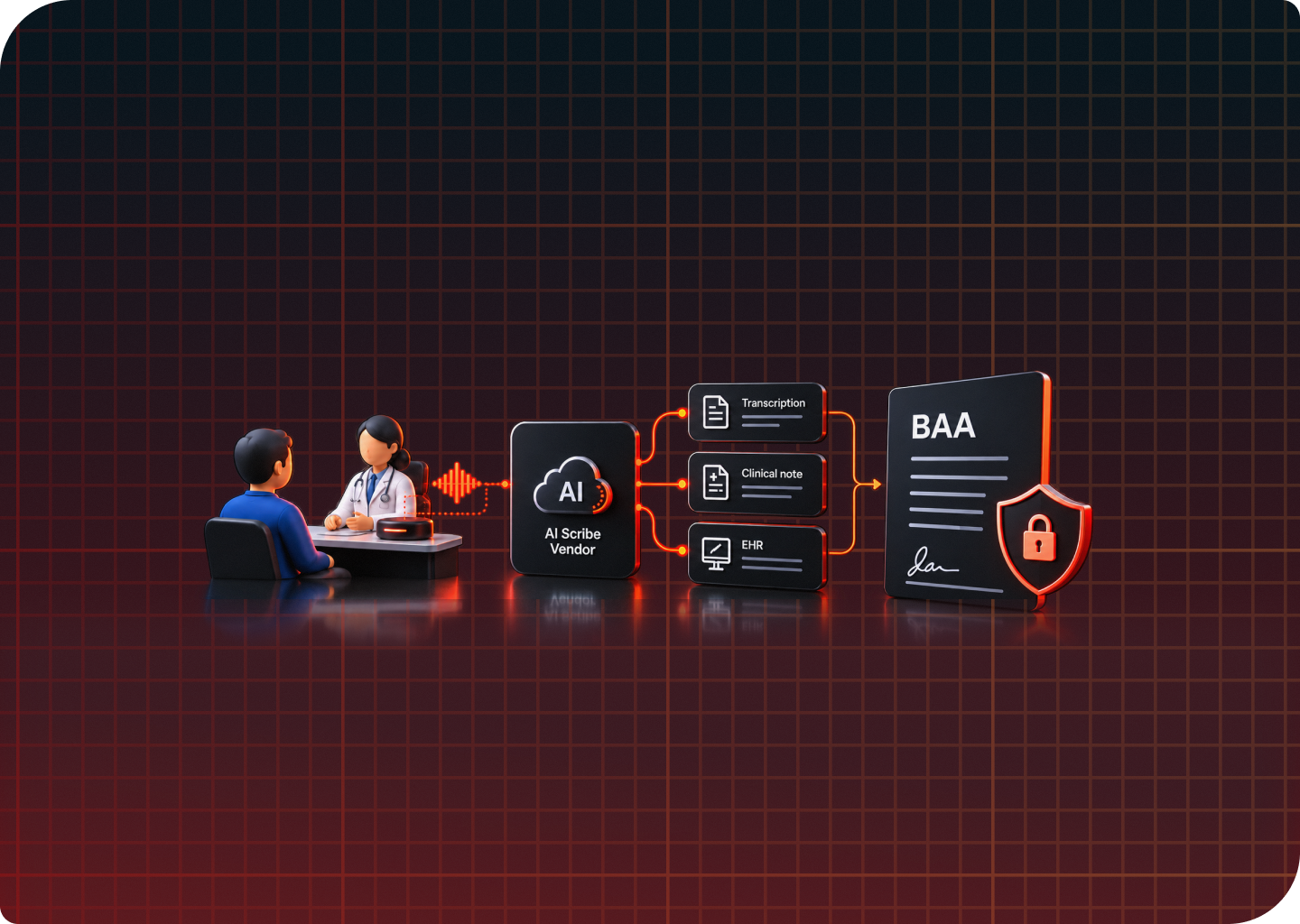
If a scribe records, transcribes or stores real patient visits, HIPAA requires a signed BAA before the first recording.
The rule is simple. But teams get stuck in applying it. In almost every vendor review we run, someone has a reason to skip the BAA. For example, the scribe is still on a free trial. The clinician installed it on a personal phone. The vendor deletes the audio right after drafting the note. Or, the transcription runs on the device, not in the cloud.
Each reason sounds fair. But in most cases, patient data still reaches the vendor, so the BAA is still required.
This guide walks you through all of it. You’ll see when an AI scribe needs a BAA and which setups trip teams up. You’ll also learn what the contract must say and how to prove your scribe is secure.
Why is BAA Required for Every AI Scribes?
HIPAA lets you share PHI with a vendor only after you get “satisfactory assurances” that it will protect the data. In practice, that means a signed business associate agreement in healthcare. The rule sits in 45 CFR §164.502(e) and §164.504(e).
AI scribe HIPAA compliance starts with one question. What does the tool actually capture? Usually more than teams expect.
In a single visit, an ambient AI scribe can collect:
- Room audio, including everyone who speaks
- The patient’s voice, which can identify them on its own
- A full transcript of the conversation
- A draft clinical note
- The final note it writes into your EHR
Each of these is PHI. And each one can live on a different server, run by a different company.
The AI Scribe Vendor Is a Business Associate
HIPAA treats any vendor that creates, receives, maintains or transmits PHI for you as a business associate. A scribe does all four in one visit.
Where teams slip is assuming the scribe vendor is the only company involved. It rarely is.
Embedded AI Scribes: When Your Product Is the Business Associate
Many digital health companies don’t buy a scribe. They build one into their product using another company’s engine. That changes your role.
Here’s how the BAA chain usually works:
- Your provider customers sign a BAA with you. You’re their business associate.
- You sign a BAA with the scribe vendor. It becomes your subcontractor.
- The scribe vendor passes the same terms to its own speech to text and AI model providers.
If one link is missing, PHI moves without a contract. And your customer’s security team will spot it.
Before you sign, ask the scribe vendor for its full list of subprocessors. Then trace PHI through every vendor in the AI workflow.
Selling to health systems? Expect them to check your evidence too. Here’s what health system buyers expect in a SOC 2 Type II review.
The BAA is unavoidable for most scribes. Yet teams still talk themselves out of it. Here’s how.
4 Reasons You Usually Skip the AI Scribe BAA, and Why They Don’t Hold Up
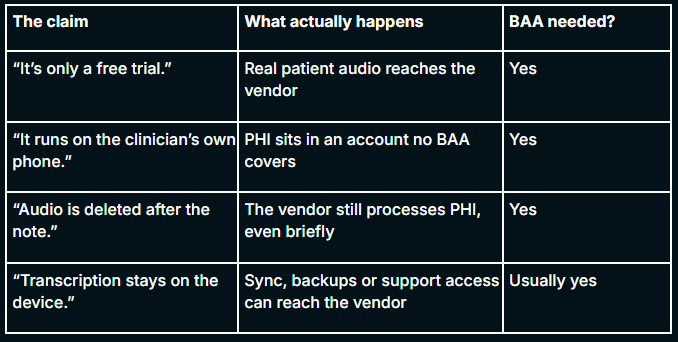
Most “we don’t need a BAA” claims about scribes fall apart on a closer look.
Some exceptions apply to every AI tool, like data stripped of all identifiers. We cover those general exceptions for any AI vendor separately. Below are the four scribe myths we hear most.
The claim
What actually happens
BAA needed?
“It’s only a free trial.”
Real patient audio reaches the vendor
Yes
“It runs on the clinician’s own phone.”
PHI sits in an account no BAA covers
Yes
“Audio is deleted after the note.”
The vendor still processes PHI, even briefly
Yes
“Transcription stays on the device.”
Sync, backups or support access can reach the vendor
Usually yes
"It's Only a Free Trial or Pilot"
A trial with real patients is a real disclosure of PHI. HIPAA gives pilots no grace period.
Sign the BAA before the first live visit. Until then, test the scribe with scripted visits your staff act out.
"The Clinician Runs It on a Personal Phone"
A clinician downloads a scribe app, signs in with a personal account and hits record. No BAA covers that account. Your practice still owns the risk.
Many unapproved AI tools behind real HIPAA violations start exactly this way. The fix is simple. Give clinicians an approved scribe that’s easy to use, then block the rest.
"Audio Is Deleted After the Note Is Drafted"
Zero retention sounds safe. But HIPAA asks whether the vendor touches PHI at all, even for a few seconds.
So, ask exactly what gets deleted, and when:
- Raw audio
- Transcripts
- Logs and error reports
- Backups
"Transcription Happens on the Device"
This one can be true. If nothing leaves the device and the vendor has no access, you may not need a BAA.
But check every way out such as cloud sync, backups, crash reports, support access and usage data. One open path brings the vendor back into scope.
Once you know you need a BAA, the next question is what it must say.
What an AI Scribe BAA Must Spell Out
Every AI vendor BAA needs the basics. Training limits, subprocessors, breach notice and audit rights. Start with our 8 AI vendor BAA clauses to redline.
An AI scribe BAA needs four more terms on top. Here’s why each one matters.
1. Separate Deletion Timelines for Audio, Transcripts and Drafts
Raw audio is the most sensitive file a scribe creates. It holds voices, names and every off the record comment.
- Give raw audio the shortest retention period in the contract.
- Set separate timelines for transcripts and draft notes.
- Ask for written proof of deletion for each.
2. Coverage for Everyone in the Room
Scribes don’t only hear the patient. They also capture family members, interpreters, nurses and students. Make sure the BAA covers everything the scribe records, not just what the patient says.
3. A Plan for Wrong Chart Notes
AI scribes can attach details to the wrong patient. Foley & Lardner warns that a note filed in the wrong chart can count as a HIPAA breach.
- Define a misattributed note as a reportable incident in the contract.
- Keep clinician review before any note gets signed.
4. Limits on What the Scribe Writes into Your EHR
Most scribes push notes straight into the EHR. That access is often wider than the job needs. Name exactly what the scribe can write, and where. Then check what PHI an AI tool can reach through your EHR before go live.
Quick gut check: Who else hears your patients?
It’s not just your scribe vendor. A speech to text engine and an AI model hear every visit too. Most teams can’t name them, and that’s where a BAA chain breaks.
Trace your entire pipeline. Book a call with us.
A tight BAA covers your vendor. But it didn’t keep you out of non-compliance.
When Only a Signed BAA Won't Stop the Lawsuit
A BAA covers one risk: your vendor mishandling patient data. A recording lawsuit asks a different question. Did patients agree to be recorded in the first place?
What Happened at Sutter Health
In April 2026, patients filed a proposed class action against Sutter Health and MemorialCare.
They claim:
- Clinicians recorded visits with Abridge’s AI scribe without meaningful, informed consent.
- The audio went to outside servers for processing, and patients weren’t told.
- This broke California’s medical privacy law, its eavesdropping law and the federal Wiretap Act.
Abridge signs BAAs with its clients, and it isn’t named as a defendant. The health systems are.
What Happened at Sharp HealthCare
Sutter wasn’t the first. In late 2025, a patient sued Sharp HealthCare over the same AI scribe. His complaint goes further than Sutter’s.
He claims:
- No one told him his July 2025 checkup was being recorded.
- His chart still said he had been told and had agreed. The complaint blames standard consent wording added to notes.
- When he asked Sharp to delete the recording, staff said the vendor keeps it for 30 days.
- Vendor staff could access recordings and transcripts, which he says broke California privacy law.
Both cases are still early, and no court has tested the claims yet.
Why the BAA Didn’t Help
Together, the two cases show six gaps a BAA can’t close. Each one applies to your scribe too.
- The BAA is a contract between you and your vendor. Patients aren’t part of it, so it can’t stand in for their consent.
- HIPAA doesn’t let patients sue, but state laws do. California’s eavesdropping law allows up to $5,000 per violation. Across thousands of visits, that adds up fast.
- The risk lands on you, not the vendor. In both cases, the health systems are the defendants.
- A consent line in the chart isn’t proof of consent. At Sharp, the chart said yes, but the patient says no one asked. A template that fills in consent by default can work against you.
- Your vendor’s retention period becomes your patients’ deletion timeline. Sharp couldn’t delete the recording on request because the vendor held it for 30 days.
- HIPAA allows vendor access, but state law may not. A BAA lets vendor staff see PHI to do the job. The Sharp complaint uses California privacy law to challenge that access.
The plaintiffs in both cases also argue that a general privacy notice isn’t real consent. If courts agree, every provider using a scribe will need a clearer consent process.
AI Scribe Consent: What to Set Up
HIPAA doesn’t require a separate patient signature when the vendor works under a proper BAA. State law is a different story.
As of 2026, 9 states require every party’s consent before a conversation is recorded, and California is one of them. With telehealth, the patient may be in a stricter state than your clinician. Plan for the stricter rule. Your consent process should answer seven questions:
- When do you ask? Before the scribe starts, not halfway through the visit.
- What do you tell patients? Say an AI tool records the visit, an outside company processes the audio and its staff may access it.
- How can patients say no? And where do you log that choice?
- Who records consent in the chart? A person should confirm it for each visit. Never let a template or the AI fill it in by default.
- Who else is in the room? Family members and interpreters need to know too.
- What happens if a patient asks you to delete the recording? Know the vendor’s retention period, and push for a shorter one in your BAA.
- Does your notice of privacy practices mention AI recording?
Then check that it works. Pull a sample of charts each month and confirm the consent notes match what actually happened in the room.
Contracts and consent forms are still paper, though. The last step is proving the scribe holds up.
How to Verify a HIPAA Compliant AI Scribe Before Going Live
A vendor can call itself a HIPAA compliant AI scribe. That’s a marketing claim, not an actual compliance. Before the scribe hears its first patient, check that its security holds up.
Ask the Vendor for Evidence
Start with documents. Ask for:
- A SOC 2 Type II or HITRUST report
- A recent penetration test summary
- Proof of encryption in transit and at rest
- MFA on every admin account
- Audit logs you can export
The same list works for any HIPAA compliant AI note taker. Just know what a SOC 2 report does and doesn’t prove for HIPAA. It shows the vendor’s controls worked over time. It doesn’t prove the scribe is safe in your setup.
AI Scribe Security Testing
This is where most reviews stop short. Documents tell you how the scribe should work. Testing shows what it actually does.
When we test an AI scribe, we look at four places:
- The recording app. Can someone pull audio off a lost phone or tablet?
- Audio and transcript APIs. Can one user fetch another patient’s files?
- Note generation. Can words spoken during a visit trick the AI into changing the note? This is called prompt injection.
- EHR access. Does the scribe’s access token reach more records than it needs?
One test matters most. Can clinician A pull patient B’s audio or note? If the answer is yes, fix that first.
Our AI and LLM security testing covers all four. Want to know what you’d get? See a sample test report.
Add the Scribe to Your Risk Analysis
An AI scribe is a new system that holds PHI. HIPAA expects it in your risk analysis, like any other system.
Update your asset list and data flow maps when you roll it out. Our guide on how to perform an application security gap assessment walks you through it.
Bottom Line
Do AI scribes need a business associate agreement? Yes, every time they touch real patient visits.
But think of protection in three layers:
- The BAA covers your vendor and its subcontractors.
- Consent covers your patients under state recording laws.
- Testing proves the scribe is actually secure.
Skip one layer, and the risk lands back on you.
Before your scribe hears its first patient, let us try to break it. KLEAP tests the recording app, transcript APIs, note generation and EHR access. Then we walk your team through every fix.
Frequently Asked Question
Do I need a BAA to trial an AI scribe?
Yes, if the trial records real patients. Any real visit sends PHI to the vendor, and HIPAA has no exception for pilots. Run the trial with scripted, staff acted visits until the BAA is signed.
Does a zero retention AI scribe still need a BAA?
Yes. A vendor that processes PHI, even for a few seconds, is still a business associate. Zero retention lowers your risk, but it doesn’t remove the BAA requirement. Ask what gets deleted and when.
Does an embedded AI scribe vendor need its own BAA?
Yes. If your product embeds another company’s scribe, that company is your subcontractor. You sign a BAA with it, and it must pass the same terms to its own speech to text and AI model providers.
Do patients need to consent to AI scribe recording?
HIPAA doesn’t require a separate signature when the vendor works under a BAA. But state recording laws can. Eleven states require every party’s consent, so ask before the scribe starts and log each patient’s choice.
Does a signed BAA protect us from AI scribe recording lawsuits?
No. The 2026 Sutter Health case was filed under California privacy law and the federal Wiretap Act, not HIPAA. A BAA governs your vendor. A clear consent process protects you with patients.