
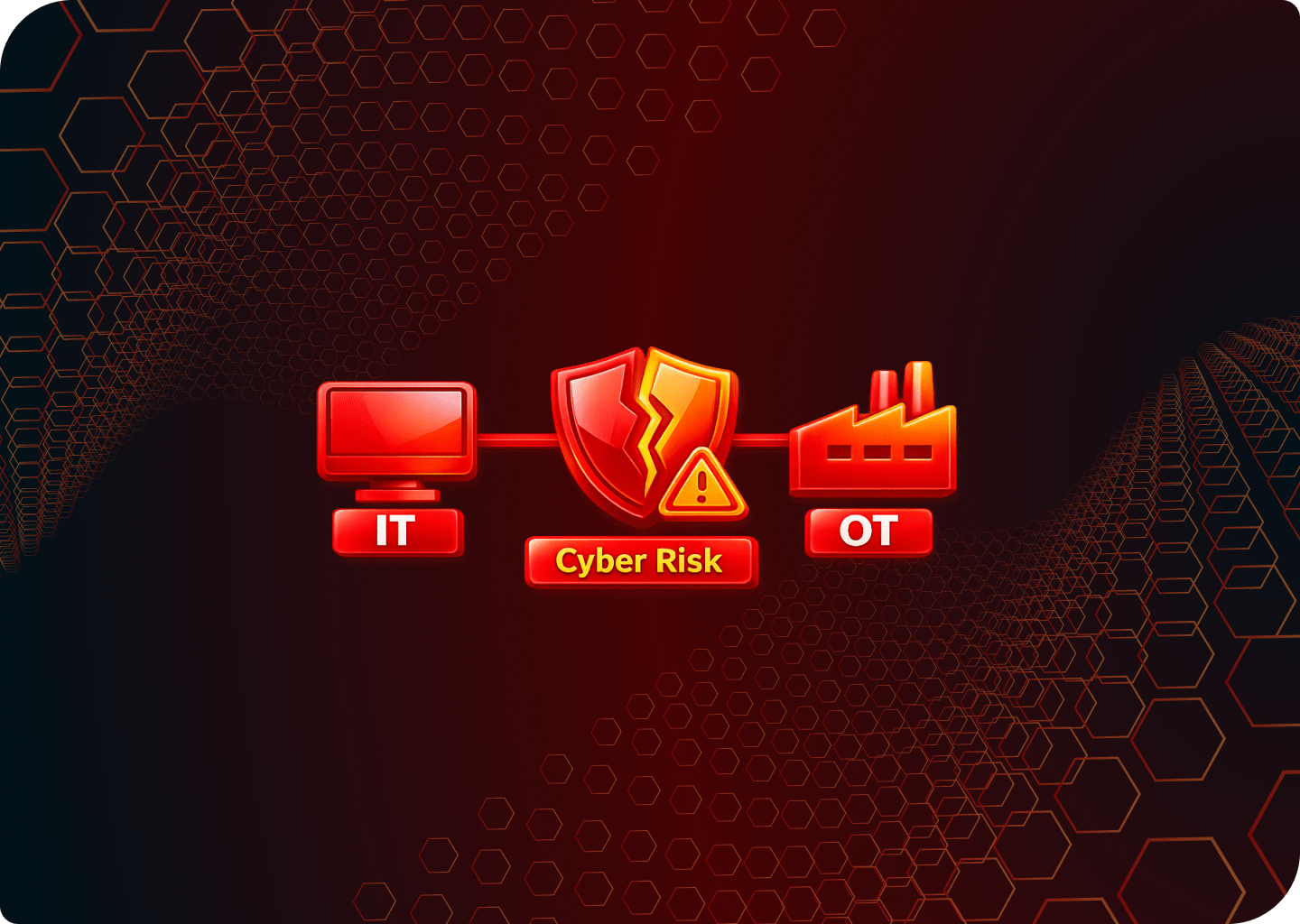
Manufacturing is now one of the most targeted sectors for cyberattacks because it combines high downtime costs, valuable intellectual property, and weak OT security. The biggest issue is IT/OT convergence. With compliance pressure rising and regulators pushing toward provable segmentation, SMBs need to verify through internal network pentesting whether controls truly hold.
Manufacturers carry two things that attackers want in the same building: intellectual property on corporate IT systems and production leverage on OT systems.
If an attacker reaches either one, the damage is immediate. Intellectual property (IP) theft drains years of engineering effort. Production disruption turns into downtime, missed delivery commitments, and direct financial loss.
The numbers reflect this. Manufacturing has been the top ransomware target for four consecutive years. Ransomware attacks on industrial organizations spiked 87% year-over-year in 2024, with 69% targeting manufacturing specifically.
Downtime costs manufacturers an average of $1.9 million per day, and the average ransom payment escalated from $199,000 in 2023 to $1.5 million in 2024. Beyond ransomware, around 40% of manufacturing attacks involve data theft targeting blueprints, designs, and trade secrets.
These are not smash-and-grab operations. Nation-state actors and organized criminal groups stake out manufacturing networks for weeks or months, exfiltrating IP that took years to develop. Chinese cyber espionage operations against manufacturing and industrial sectors rose 300% in 2024.
In many cases, the attacker does not need an advanced perimeter bypass. The real damage happens after initial access, when they move through the internal network, find weak boundaries, and reach systems the organization assumed were isolated.
That is where internal network pentesting matters. A VLAN, a firewall rule, or a network diagram may suggest separation, but only a thorough penetration test shows whether that separation actually holds.
How Manufacturing Networks Stay Structurally Exposed
Manufacturing IT security carries a structural problem that many other sectors do not. The same facility often contains two very different environments: corporate IT and OT.
The corporate side includes Active Directory, file servers, ERP systems, engineering workstations, and email. The OT side includes PLCs, HMIs, SCADA servers, historians, and industrial control systems that often cannot be patched or restarted on normal IT schedules.
As manufacturers have adopted connected production systems, remote monitoring, and cloud-based ERP integrations, the air gap that once separated IT from OT has been systematically bridged.
The convergence of these two environments has been the defining manufacturing cybersecurity trend of the past decade. Today, 75% of OT attacks begin as IT breaches; attackers enter through a phishing email or compromised VPN credentials, then pivot from the corporate network to production systems.
The scale of exposure is significant. In 2024, 65% of OT environments assessed had insecure remote access conditions, including default credentials, unpatched VPNs, and exposed RDP sessions. One in every four penetration tests of industrial environments finds default credentials still in use on OT systems.
These are the oldest techniques in the playbook, still working because the environments have never been tested.
This is why manufacturing network security cannot rely on architecture intent alone and needs validation under realistic attack conditions.
Where Internal Pentests Consistently Find Failure Points
Across manufacturing environments, internal network pentesting tends to uncover the same three problems.
First, segmentation exists on paper but not in practice. Teams may believe corporate IT, engineering systems, and OT zones are separated, yet years of routing exceptions, temporary workarounds, and inherited configurations leave live paths between them. A compromised office workstation should not be able to reach an engineering file share or an OT-adjacent jump host.
Second, service accounts become incursion points. Manufacturing environments rely on integration accounts to connect ERP systems, historians, SCADA tools, and remote monitoring platforms. These accounts often carry more access than they need and are rarely reviewed. One compromised service account can provide clean lateral movement across the internal environment.
Third, legacy systems remain exposed on the new network. Many OT assets cannot be patched on standard schedules, but that does not reduce their risk. It increases the importance of isolation. If vulnerable devices remain reachable from broader network segments, they become the easiest path forward for an attacker who has already gained a foothold.
What Does an Internal Network Pentesting Uncover?
An internal network pentesting engagement assumes the attacker is already inside. That initial access could come from a phishing email, a contractor laptop, a compromised VPN account, or an exposed remote access pathway.
In manufacturing environments, the test should cover the corporate side, the IT/OT boundary, and the systems that connect both. That usually means evaluating:
- Active Directory and identity exposure, including stale credentials, privilege escalation paths, and over-permissioned service accounts.
- Network boundary validation between corporate IT, engineering environments, and OT-adjacent systems.
- Lateral movement opportunities using common internal techniques such as credential abuse, SMB access, and built-in Windows tools.
- Boundary systems such as historians, engineering workstations, jump hosts, and MES integrations.
- Credential and configuration exposure, including default credentials, weak password practices, and discoverable secrets in scripts or shares.
The output should document the path an attacker could take in real time, what they could access, and which controls failed to stop them.
Why Assumed Segmentation Does Not Count as Compliance Proof
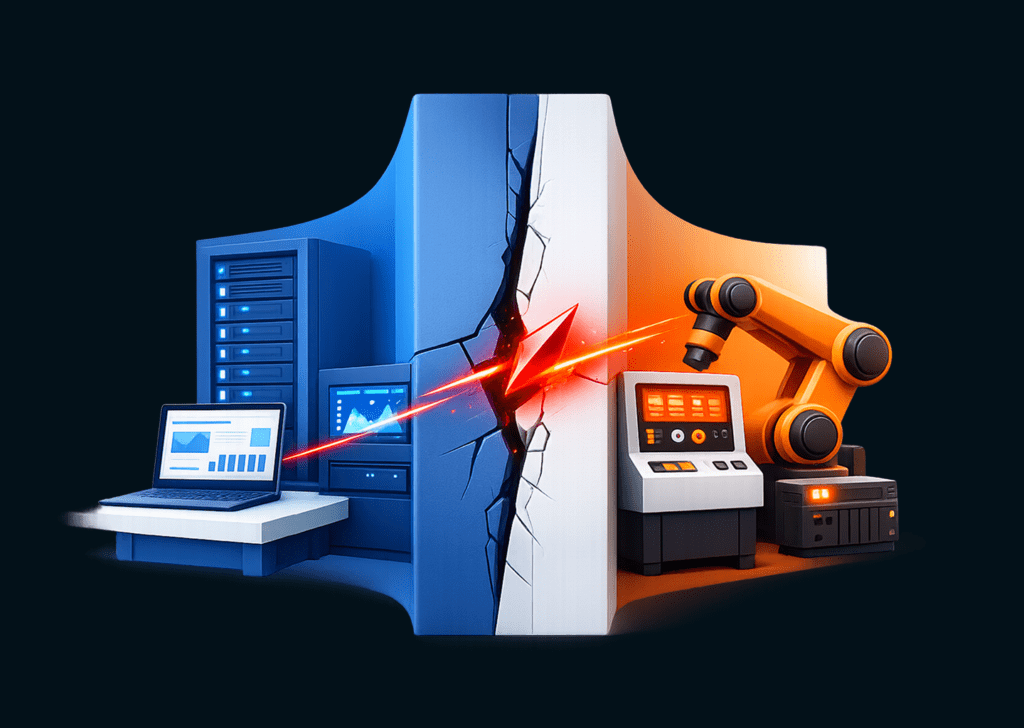
Most manufacturers have already done some segmentation work. That is not the issue.
The issue is confidence without testing. Over time, environments drift. Exceptions are added to support production. Remote access tools stay active longer than planned.
Legacy systems remain in the wrong zone because moving them is risky or disruptive. None of these decisions look severe in isolation. Together, they create exactly the paths attackers use.
In manufacturing IT security, a segmentation claim should be treated like any other control claim: if it has not been validated, it is still an assumption.
Compliance pressure is rising, with ISO 27001, IEC 62443, CMMC 2.0, and NIS2 all pushing toward stronger and more provable segmentation.
Regulatory frameworks: IEC 62443, the primary OT security standard, requires verified segmentation through its zones and conduits model. NIST SP 800-82 guides industrial control system security with explicit requirements for network separation validation.
Both frameworks are moving toward requiring independent testing, not self-assessment.
Insurers, major customers, and auditors are all moving in the same direction – they want evidence that security controls are in place and will hold in the event of a breach.
What KLEAP’s Internal Network Pentesting Scope Covers
A weak scope produces weak answers. A meaningful internal assessment has to reflect how the plant really operates.
That means including corporate IT systems, IT/OT boundary systems, OT-adjacent assets where safe to assess, and the remote access infrastructure that often provides the initial foothold.
Remote access paths: VPN infrastructure, RDP exposure, third-party remote monitoring tools, and any path into the internal network that does not originate on the corporate LAN.
20% of OT incidents in 2024 involved exploitation of remote access, making this a non-negotiable component of the scope.
Rules of engagement also matter. Testing near production systems must be coordinated carefully.
No payload execution on live control systems. No actions that risk device stat changes.
Clear communication with OT owners before any active validation near sensitive assets. That is how manufacturing cybersecurity testing stays technically credible without creating operational risk.
Manufacturing network security is proven only when someone actively tries to cross those boundaries and documents what they find.
That is the value of internal network pentesting. It shows whether a compromised corporate asset can move toward engineering systems, whether service accounts create hidden trust paths, and whether legacy assets are still reachable from parts of the network they should never be exposed to.
KLEAP’s approach to manufacturing cybersecurity is built around that validation step.
We scope and execute internal network penetration tests across the IT/OT boundary, assess lateral movement paths, validate segmentation controls, and produce evidence-based reporting that supports remediation, governance, and defensible risk decisions.
If you’re a manufacturer on the lookout for a reliable security and compliance service provider, connect with us.
