
Critical access hospitals operate with lean teams, rural constraints, and limited margin for disruption. That makes HIPAA compliance harder to maintain and easier to overestimate. This blog explains the attack patterns CAHs keep facing, what OCR expects now, and what year-round compliance should actually look like.
Critical access hospitals (CAHs) operate under structural constraints that change how security and HIPAA compliance work in practice.
The Centers for Medicare & Medicaid Services (CMS) specifies that CAHs must maintain no more than 25 inpatient beds, keep an average length of stay of 96 hours or less, and meet rural distance criteria. That model keeps rural healthcare accessible.
But it also means security teams are usually lean, budgets are tight, and their IT environment tends to become outdated quickly.
A rural healthcare survey reported that 73% of rural organizations struggle to maintain HIPAA compliance due to staffing and funding gaps, and it points to additional barriers like legacy systems, limited vendor support, and tools that create workflow friction.
This is exactly why CAH HIPAA compliance often collapses during real breaches: the program is under-resourced, while the threat environment is moving faster.
Now add the threat model. Microsoft’s analysis of 13 hospital systems, including rural hospitals, found 93% of malicious activity was tied to phishing campaigns and ransomware, with most activity being email-based.
So, the risk for many critical access hospitals is not zero-day exploits or sophisticated cyber techniques. It’s the basics: email, identity, credentials, patching cadence, and recovery.
This is why a CAH HIPAA compliance assessment can look complete on paper but fail in practice. If you can’t show operating safeguards and retrieve evidence quickly, you’re exposed the moment ransomware forces downtime decisions.
And because CAHs are clinical lifelines, the cost is not only a compliance risk but also translates to delayed care, diverted patients, and operational disruption.
In this blog, we’ll explain the rural-first attack patterns that keep repeating, what that means for control priorities, and evidence that CAHs should keep ready year-round.
Security Threats to Rural & Critical Access Hospitals in 2026
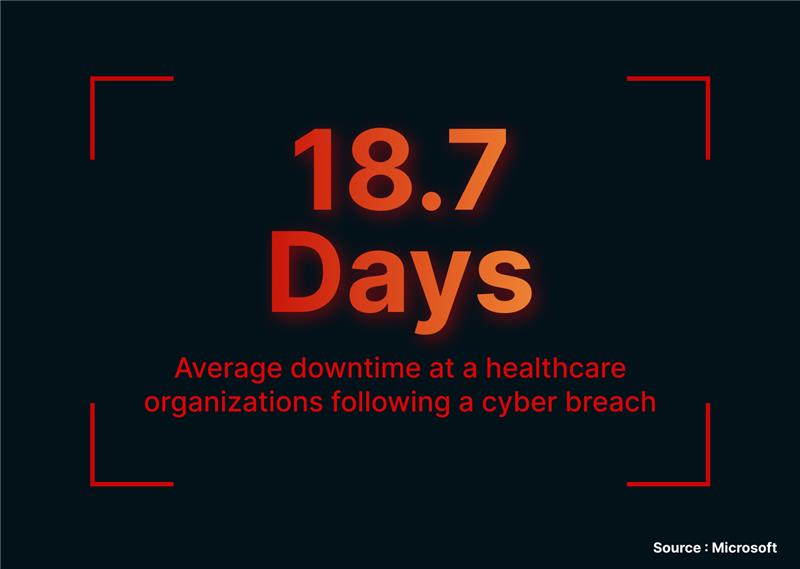
The most common cyberattack story is a repeatable chain that punishes lean teams and aging systems: email compromise → credential misuse → ransomware. In plain terms, attackers don’t need a deep exploit. They need one staff member to click, one password to reuse, and one account that opens the next door.
- Entry
CAHs are identified as vulnerable to email-based threats due to older IT systems, patching gaps, and weak identity/credential management.
- Escalation
Identity and Access Management (IAM) workflows in CAHs aren’t routinely reviewed, which allows attackers the ability to entrench ransomware deeper into systems.
- Execution
When a CAH’s systems are breached, the disruptions not only include financial losses, but they also compromise healthcare in a large area because there are fewer alternate sites nearby and patients already travel long distances for care.
CAHs are the most at-risk sector within the U.S. healthcare ecosystem because they operate under structural strain. NRHA frames rural hospitals as a lifeline for nearly 14% of the U.S. population (about 46 million people) and highlights that limited budgets make it hard to implement key cybersecurity measures, leaving hospitals more exposed to cyberattacks.
This context matters for CAH HIPAA compliance because security gaps become healthcare continuity problems.
The March 2022 ransomware attack on McKenzie Health System, a CAH in Sandusky, Michigan, shows why disaster recovery planning and offsite redundancy matter. CEO Steve Barnett said the likely entry point was a phishing email that bypassed spam controls, and the attacker demanded a seven-figure ransom, threatening to leak Protected Health Information (PHI) on the dark web.
As the team confirmed the intrusion was more contained than first feared and restoration was already underway, McKenzie made the call not to pay. IT restored systems to a point roughly 12 hours before the attack. Leadership also documented their posture and actions, noting preventive training, firewalls, and other safeguards, with the expectation that this evidence would matter in any future review or audit of the incident.
This is why rising HIPAA scrutiny matters even more for CAHs. If you can’t restore systems and prove what happened, the hospital ends up working blind while trying to keep care moving, and you’re opening yourself up to an OCR investigation.
What the OCR expects from CAHs for HIPAA Compliance
The hard part for CAHs is keeping compliance defensible when staff and funding are stretched. Proposed updates to the HIPAA Security Rule were explicitly meant to strengthen cybersecurity protections for ePHI and provide more specific instructions on what regulated entities must do.
The 2024–2025 HIPAA audit program was geared toward Security Rule provisions most relevant to hacking and ransomware.
That was a signal of the compliance standard moving from policy displays to provable evidence of functioning security controls that are being periodically updated.
Written inventories, updated risk analysis triggers when environments change, and other operational requirements that push organizations toward continuous evidence rather than point-in-time readiness.
This is where CAH HIPAA compliance assessments fall short. They document intent but don’t always confirm operational proof in the form of
A living risk analysis tied to action
Not a yearly report. A current written assessment that changes when systems, workflows, or threats change, and that feeds a remediation plan.
Safeguards that reduce ransomware impact
HHS’s Healthcare and Public Health Cybersecurity Performance Goals (HPH CPGs) are designed to set up safeguards that better protect the CAH sector, improve response, and minimize residual risk.
Healthcare-specific playbook to prioritize controls
HHS’s 405(d) Health Industry Cybersecurity Practices (HICP) is built for healthcare organizations to manage threats that impact patient safety, and it maps common threats to practical security practices.
The CAH Evidence Pack HIPAA Auditors Care About
- Risk analysis + last update date + what changed since last review
- MFA coverage proof for email and remote access
- Backup and recovery test results
- Vendor access inventory + who approved persistent access
- Log review cadence notes + exceptions and follow-ups
- Incident runbook + last tabletop notes + decision log for downtime scenarios
What CAH HIPAA Compliance Looks Like Between Assessments
For critical access hospitals, HIPAA compliance between assessments must stay current in four areas: risk, access, recovery, and vendors. Because rural healthcare facilities are the most susceptible to cyberattacks, compliance cannot sit as an annual document set. It has to function as an operating routine.
First, risk analysis has to stay current. HHS’s proposed Security Rule changes push covered entities toward an ongoing technology asset inventory, a network map showing how ePHI moves, and a written risk analysis that is updated when operations or the environment change. That means a new vendor connection, remote access change, workflow shift, or delayed patch cycle should trigger review and action.
Second, control priorities should match the attack path that keeps repeating in rural hospitals. So, between assessments, CAHs should stay focused on email protection, MFA, credential hygiene, and fixing known vulnerabilities before they become the next entry point.
Third, recovery proof has to stay ready. HHS is clear that backups alone are not enough. CAHs need to verify that they can recover from backups, conduct test restorations, consider offline backups, and maintain contingency planning that includes disaster recovery, emergency operations, criticality analysis, and periodic testing.
Fourth, vendor exposure has to stay in scope. CAHs must keep a current vendor access inventory, review persistent access, and maintain clear records of who has access, why they have it, and who approved it.
It’s a small but active cadence that keeps you HIPAA-compliant and audit-ready.
Why CAHs Need a Concierge for Year-Round HIPAA Compliance
Healthcare cybersecurity already requires a broad view of systems and risk surfaces, and compliance adds ongoing work that needs steady attention. Critical access hospitals need a HIPAA compliance service delivery model that matches how rural healthcare actually operates.
KLEAP’s concierge model of service delivery is built around turning compliance requirements into a working roadmap with owners, cadence, and an evidence engine that stays current across the program.
- Stay compliant as systems, workflows, and vendors change.
- Security gaps are assigned, tracked, and pushed toward closure.
- Documentation, control proof, and review records stay organized and retrievable.
- Internal staff are not left to manage remediation, follow-ups, and evidence collection alone.
- Compliance work stays tied to operational resilience and improving security posture.
For CAHs, that kind of support is what helps HIPAA compliance stay current and defensible year-round. Need a clear scope, quickly?
