
Health-tech startups have a predilection for prioritizing technology.
But there comes a time when prioritizing compliance too becomes paramount. Enterprise clients ask for a SOC 2 report, someone reminds you of HIPAA, and enterprises want to see a HITRUST certification before holding more talks.
If you have no idea about the compliance frameworks, your instinct will be to treat all three as interchangeable (which they are not). And you may feel under pressure as your clients keep asking you to prove you’re compliant.
That pressure is not arbitrary.
Healthcare has been the most expensive industry for data breaches for fourteen consecutive years. The 2025 IBM Cost of a Data Breach report puts the average healthcare breach cost at $7.42 million, with an average of 279 days to identify and contain an incident, which is the longest of any sector.
Vendors are increasingly becoming the focal point of data breaches. In February 2024, a ransomware attack on Change Healthcare, a claims clearinghouse and business associate that processes roughly one-third of U.S. patient records, exposed the protected health information of approximately 190 million individuals.
It was the largest healthcare data breach on record. A $22 million ransom was paid to the BlackCat group, and recovery stretched across months of disrupted claims and payments nationwide.
Change Healthcare was not an outlier. According to HIPAA Journal’s 2026 report, 136 business associates reported a data breach out of a total of 772 reported instances between 2009 and 2026. Eight of the fourteen healthcare breaches in 2024 that each exceeded one million records occurred at business associates of HIPAA-covered entities.
The takeaway is that vendors are increasingly becoming soft targets. Enterprise customers no longer take a vendor’s security posture on faith. They demand independent proof of SOC 2 and HITRUST, and expect you to be HIPAA-compliant.
Now, it is understandable that, as a startup, choosing the wrong order of compliance or treating all three as one undifferentiated project, is how you’ll burn your budget on an audit no customer asked for.
That is why this blog breaks down how SOC 2 for healthcare fits alongside HIPAA and HITRUST, and how a startup with a finite budget and headcount should decide what to pursue first.
Where Do HIPAA, SOC 2, and HITRUST Overlap and Diverge?
Before deciding what to pursue first, a security leader has to see why these three are not interchangeable. They are three different categories of obligation, and the differences decide the order.
HIPAA is a legal mandate. Even if you are not creating PHI, if you’re receiving, maintaining, and transmitting it, it means you’re still bound by the HIPAA Security Rule, and you need to sign a Business Associate Agreement (BAA) with your covered entity.
The common misconception is that HIPAA is a certificate. Let’s dispel that once and for all.
There is no HIPAA certification body and no HIPAA certificate. Meanwhile, SOC 2 is an attestation. It is a report produced by a licensed CPA firm against the AICPA’s Trust Services Criteria. It does not levy fines on you like OCR does for HIPAA violations, but documents whether stated controls are designed and operating as described.
And this brings us to HITRUST, which is a certification. It is awarded against the HITRUST CSF that brings the best risk-management and security controls of HIPAA, NIST, and ISO under one roof.
The table below summarizes how SOC 2 for healthcare, HIPAA, and HITRUST compare across the dimensions that matter most:
Dimension
What it is
Federal law
AICPA attestation report
Certification against the HITRUST CSF
Type of obligation
Legal mandate
Customer-driven attestation
Customer-driven certification
Issued / judged by
OCR (enforcement). It has no certifying body
Licensed CPA firm
HITRUST, via an authorized external assessor
Credential produced
HIPAA is not a certification. But you pass or fail an audit by OCR
Attestation report
Pass/fail certificate
Primary trigger
Handling PHI
Enterprise procurement and vendor security reviews
Contractual requirement from a client, partner, or enterprise customer
Scope basis
Risk-based safeguards for PHI
Trust Services Criteria
Prescriptive control set mapping HIPAA, NIST and ISO
Cadence / validity
Ongoing legal duty
Type II covers a 6 to12-month window
e1 and i1 one year, and r2 two years with interim
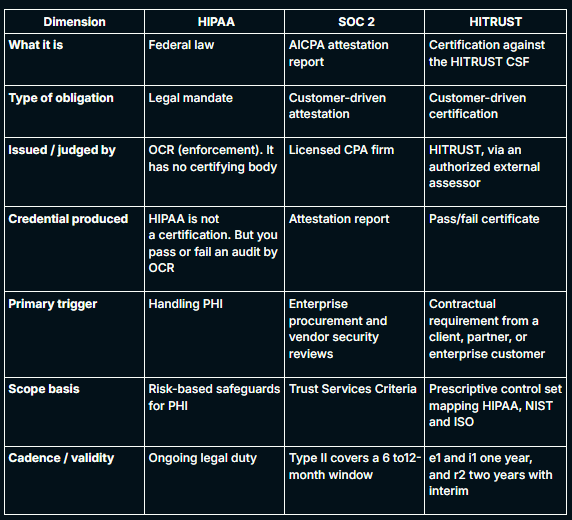
HIPAA demonstrates legal due diligence to a regulator (in this case OCR) and produces documented evidence, not a certificate. SOC 2 demonstrates operating effectiveness to a customer’s security team and produces an attestation report.
And HITRUST demonstrates certified conformance to the most demanding buyers and produces a pass/fail credential. The same controls sit underneath all three frameworks while the artifact is different in each case. That is why the order in which a startup pursues them matters.
Yes, they have different purposes. But they also shared the same foundation of security controls. Let’s see what the controls are where they overlap:
- Risk assessment and risk management
- Access control and identity management
- Encryption of data at rest and in transit
- Audit logging and monitoring
- Incident response and breach handling
- Vendor and third-party risk management
The HIPAA Security Rule’s safeguards map heavily onto SOC 2’s Security (Common Criteria) category and onto the HITRUST CSF.
A SOC 2 examination can even be run as a “SOC 2 plus” engagement that maps the same controls to HIPAA and HITRUST. You have to build the control set once, and most of the underlying evidence is reusable across all three.
Book a slot with us:
Where Does Each Framework Fit a Healthtech Startup?
With the relationship between HIPAA, SOC 2, and HITRUST clear, let’s answer the question that has been on everyone’s mind: For a growing healthtech company, where does each framework fit? And while we are at it, let’s also answer the order in which to implement them.
Why Does HIPAA Come First?
Since HIPAA, SOC 2 and HITRUST have overlapping controls, you should start with a common risk assessment, and then map the common controls to any of the frameworks whenever needed.
But HIPAA should come first because it’s a regulatory requirement. Plain and simple. Also because HITRUST is expensive, and it is the same for SOC 2 as well.
You can go without SOC 2 and HITRUST before any buyers asks you about it. But HIPAA is needed for business continuity.
You should be wary of compliance automation platforms that generate scores, as a high score is not a certificate. Because HIPAA has no official certification, a vendor that claims to be “HIPAA certified” is describing something that does not exist. What withstands an OCR investigation is documented evidence: a risk analysis, implemented safeguards, and signed agreements down the vendor chain.
The proposed 2026 overhaul of the HIPAA Security Rule, published on January 6, 2025, is yet to become a final rule. But as of now, it would remove the “addressable” versus “required” distinction and make controls such as multi-factor authentication, encryption, and annual penetration testing mandatory. Until a final rule issues, these are proposals to prepare for.
What Are the SOC 2 Type II Requirements for Healthcare?
When a digital health company sells to an enterprise-level hospital client, the vendor security review almost always asks for a SOC 2 report before the deal moves forward.
A SOC 2 examination is scoped against five Trust Services Criteria: Security, Availability, Processing Integrity, Confidentiality, and Privacy. Security, the common criteria, is the only category required in every report, while the others are added based on the service and what customers ask for. The criteria were published by the AICPA in 2017 and updated with revised points of focus in 2022.
The distinction that matters most is Type I versus Type II. A Type I report assesses whether controls are designed appropriately at a single point in time. A Type II report assesses whether those controls are operating effectively across a window of six to twelve months, and it is the report enterprise buyers in healthcare expect to see.
In practice, the SOC 2 Type II requirements for healthcare come down to evidence generated continuously over the assessment period before an audit. Across the period, auditors expect to see the following records:
- Access reviews and user provisioning / de-provisioning logs
- Change management tickets and approvals
- Incident response logs and post-incident reviews
- Vulnerability scan and penetration test results
- Vendor and subprocessor risk assessments
- Security awareness training completion records
A startup that has not been running these processes for months cannot produce a clean SOC 2 Type II report. That is why the timeline, not the budget, is a bigger constraint on SOC 2 for healthcare.
When Does HITRUST Become Worth It?
For many startups, HITRUST comes last. The current framework, CSF v11.7, was released in December 2025, and offers three tiers that let an organization grow its assurance level.
e1
44 requirement statements (essential cyber hygiene)
Entry-level
Early-stage startups signaling baseline maturity
i1
182 requirement statements (leading practices); baseline for r2
Moderate
Companies needing stronger assurance and faster recertification
r2
200+ tailored controls; two-year validity with interim check
Highest
Established vendors a payer or large health system requires to certify
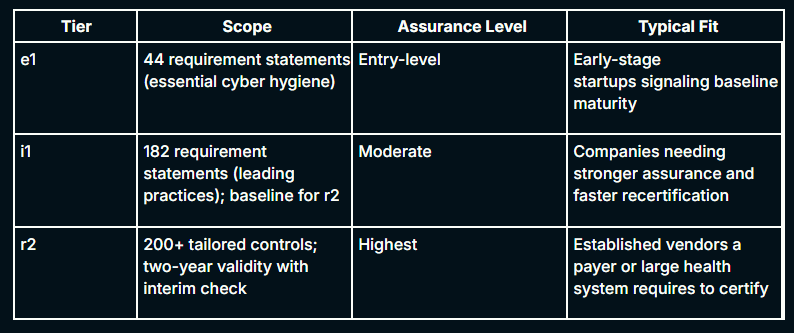
Because HITRUST is the only certification of the three, it carries the most weight with the most demanding buyers. It is typically required by health plans and large health systems that name it in contracts.
For most early-stage healthtech companies, an e1 can be a sensible entry level, while a full r2 is an enterprise-readiness investment to grow into once a specific contract justifies the cost and effort. Treating HITRUST as a day-one requirement, before a customer has asked for it, is a common and expensive mistake.
How Should a Healthtech Startup Sequence HIPAA, SOC 2, and HITRUST?
A clean decision frame will help you prepare for all three compliance frameworks. There are four steps to it that holds across almost every healhtech startup company:
- Establish the HIPAA baseline first.
Complete a documented risk analysis, implement administrative, physical, and technical safeguards proportionate to the risks, and put Business Associate Agreements in place before any vendor touches PHI. This is non-negotiable and underpins everything that follows.
- Pursue SOC 2 for healthcare when revenue depends on it.
If you want to earn higher revenue with an enterprise client, start the SOC 2 process. Many teams begin with a Type I to unblock an immediate deal, then run the observation window toward the Type II that enterprise buyers ultimately require.
- Reserve HITRUST for a contract that names it.
When a large health system requires HITRUST certification, scope the right tier (an e1 or i1 before an r2) rather than going for the highest assessment.
- Build the controls once and map them across frameworks.
The HIPAA risk analysis feeds the SOC 2 control set, which in turn maps to the HITRUST CSF. Sequencing the work so it compounds is the difference between one maturing security program and three parallel, redundant audits.
Of note, you need to remember two things. Firstly, a readiness score from an automation platform is not proof of anything to a customer or a regulator. And second of all, the cost ranges quoted for HITRUST tiers vary widely with scope, so they should be validated against an assessor’s quote for your environment rather than taken as fixed figures.
How Can KLEAP Help?
KLEAP works with digital health platforms, healthtech startups, and healthcare organizations to sequence HIPAA, SOC 2, and HITRUST so that each engagement builds on the last instead of repeating it.
KLEAP’s work is manual and evidence based. We do not hand over automated scan reports repackaged as compliance deliverables.
KLEAP follows a concierge model. Every compliance and advisory engagement is led by a dedicated expert who understands the specific PHI flows and architecture of a given product category.
We stay with you from the HIPAA posture through SOC 2 for healthcare readiness and into HITRUST certification when a contract calls for it.
The question that matters the most for a healthtech startup is not whether the company is compliant in principle. It is whether the company has picked the right framework, in the right order, and can demonstrate it with documented evidence when a customer or a regulator asks. That is where the conversation starts.