
Every week Over 300 million people ask ChatGPT health related questions. For healthcare organizations, AI-generated answers are becoming a measurable source of patient traffic.
Now 94% of enterprises plan to increase AEO investment in 2026, after putting an average 12% of digital budgets into it last year.
However, more spend means more pressure to prove it works. That pressure is where the risk hides. The tools used to measure AI traffic can create privacy risks. Analytics platforms, tracking pixels, referral tags, and conversion scripts may collect or share protected health information (PHI) without your knowledge.
Kaiser Permanente learned this the expensive way. Kaiser is the largest nonprofit health system in the US, acting as both an insurer and care provider for its members. In late 2025, it agreed to pay up to $47.5 million to settle claims that tracking code on its websites and apps shared data from up to 13.4 million members.
Yet most AEO attribution advice only explains how to tag AI referrals. It rarely mentions what your tracking stack shares while you measure them.
HIPAA compliant AEO attribution tracks which AI answers drive patient visits and conversions while keeping PHI out of every tag, report, and tool behind it. This guide shows how.
What is HIPAA Compliant AEO Attribution?
HIPAA compliant AEO attribution measures AI-driven traffic and conversions without exposing patient data. Attribution shows which answers in ChatGPT, Perplexity, and Google’s AI Overviews send visitors to your site, and what those visitors do next. Your content is public. The visitor data you collect is not.
To prove AEO results, teams add new tools like analytics platforms, tracking pixels, session recorders, and call tracking software. Each one opens a new path for patient data to leave your control. Most teams add these tools without checking where the data goes.
Here are the seven places where that breaks down.
Where AEO Attribution Creates HIPAA Risk: 7 Ways PHI Leaks
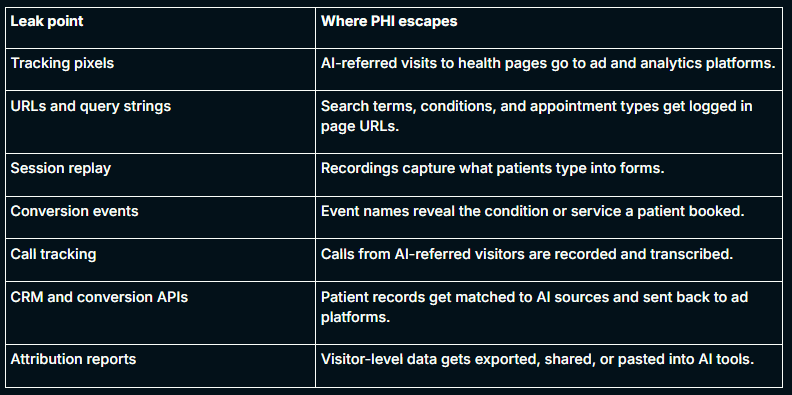
A typical AEO attribution stack includes an analytics platform, tracking pixels, session replay, form and booking tools, call tracking, a CRM, and a reporting dashboard. Every one of them records what visitors do after an AI answer sends them to your site. The table below shows the seven most common leak points.
Leak point
Where PHI escapes
Tracking pixels
AI-referred visits to health pages go to ad and analytics platforms.
URLs and query strings
Search terms, conditions, and appointment types get logged in page URLs.
Session replay
Recordings capture what patients type into forms.
Conversion events
Event names reveal the condition or service a patient booked.
Call tracking
Calls from AI-referred visitors are recorded and transcribed.
CRM and conversion APIs
Patient records get matched to AI sources and sent back to ad platforms.
Attribution reports
Visitor-level data gets exported, shared, or pasted into AI tools.
1. Are Tracking Pixels HIPAA Compliant for AEO Attribution?
Not if they disclose PHI to vendors without a business associate agreement (BAA).
AEO often involves creating pages around specific conditions and treatments. But tracking pixels can collect page visits alongside identifiers, while session replay tools may capture information patients enter into forms.
Google Analytics doesn’t offer a BAA, and Meta Pixel isn’t covered by one either. Neither should receive PHI. HIPAA-compliant analytics requires keeping PHI out of these tools or using appropriately safeguarded vendors with BAAs.
HHS first warned about healthcare tracking technologies in December 2022 and revised its guidance in 2024. A June 2024 court ruling also clarified that an IP address combined with a visit to a public health-related page does not automatically trigger HIPAA obligations.
The clearest risks remain on patient portals, authenticated pages, and forms collecting PHI.
Even outside HIPAA, the FTC’s Health Breach Notification Rule and state laws like Washington’s My Health My Data Act can still apply.
2. How URLs and Query Strings Leak PHI in AI Traffic Tracking
Every page URL your analytics tool records is data you’ve shared. Most teams never check what those URLs contain.
AI tools often tag their links with source parameters, which is how you know a visit came from ChatGPT or Perplexity. That part is safe. The risk comes from your own site. Symptom checkers, doctor finders, and booking flows often put search terms, conditions, or appointment types into the URL. Analytics tools log the full URL by default.
For HIPAA compliant AEO attribution, strip sensitive parameters before data leaves the page. Keep the AI source tag and drop everything else.
3. Is Session Replay HIPAA Compliant on AEO Landing Pages?
Only if it never sees PHI. Most session replay tools record by default.
Teams use session replay to see how AI-referred visitors behave. The recordings capture clicks, scrolls, and often what people type into intake and booking forms. Masking settings help, but new form fields added after setup are often left unmasked.
For HIPAA compliant AI marketing attribution, turn session replay off on forms, portals, and booking pages. Use it only on pages with no patient input.
4. HIPAA Compliant Conversion Tracking: When Event Names Disclose PHI
Attribution needs conversion events. The names you give those events can reveal a diagnosis.
An event called “booked oncology consult” or “submitted fertility form” tells your analytics vendor what care the visitor wants. Combined with a device ID or IP address, that event can become PHI.
Use generic event names like “appointment booked” or “form submitted.” Track the service line inside your own HIPAA compliant systems, not in third-party tools.
5. Is Call Tracking HIPAA Compliant for AI-Referred Calls?
Only if the vendor signs a BAA. Many patients still call after reading an AI answer.
Call tracking assigns unique numbers to AI-referred visitors, so you can tie calls back to their source. The software then records calls, transcribes them, and often scores them with AI. Patients share symptoms, medications, and insurance details on those calls.
Without a BAA, every recording is an unauthorized disclosure. Check whether the vendor’s AI call analysis runs under the same BAA.
6. CRM and Conversion APIs: Where Closed-Loop Attribution Breaks HIPAA
Closed-loop attribution connects an AI-referred visit to a booked patient. That connection is where risk peaks.
Teams sync AI source data into the CRM, match it to patient records, and send conversions back to ad platforms through conversion APIs. Those APIs often send hashed emails or phone numbers. Hashing doesn’t make data anonymous, because the hash is built to match a real person on the other end.
You need to keep patient-level matching inside BAA-covered systems. Send ad platforms aggregated or de-identified results only.
7. HIPAA Compliant Attribution Reporting: How Dashboards Expose PHI
The final leak point is the report itself. Attribution data moves fast once it reaches a dashboard.
Teams export visitor-level data to spreadsheets, share dashboards with agencies, and paste results into AI tools for analysis. If that data includes IP addresses, device IDs, or patient matches, each step is a new disclosure.
Under HIPAA, vendors handling PHI on your behalf generally need a signed BAA, and that includes your agency and reporting tools. Report AEO results at the aggregate level wherever possible.
As your attribution stack grows, each new tool needs the same scrutiny.
How to Build a HIPAA Compliant AEO Attribution Program
A HIPAA compliant AEO attribution program measures AI-driven traffic and conversions through the same controls that protect the rest of your patient data. It starts with knowing where your tracking data goes and ends with your HIPAA risk assessment. These eight steps help mitigate the seven leaks above.
1. Map Every Data Flow in Your Attribution Stack
You can’t protect data you haven’t traced. List every analytics tool, pixel, tag, form, call tracking number, CRM sync, and dashboard your AEO measurement uses. For each one, write down what data it collects, where it sends that data, and who can see it.
Keep this map to one page. It shows you where PHI could leak, and it becomes the starting point for your risk assessment in the final step.
2. Sign a BAA Before Any Attribution Tool Touches PHI
Any vendor handling PHI on your behalf, whether an analytics platform, call tracking tool, CRM, or agency, generally needs a signed BAA. If they won’t sign one, don’t send them PHI.
But a signed BAA doesn’t guarantee data security. You still need to know where your data goes, how long the vendor keeps it, and whether it feeds the vendor’s own AI or ad models.
3. How to De-Identify Patient Stories for AI Search
Before publishing case studies, testimonials, or healthcare schema markup, make sure they contain no identifiable patient information. HIPAA allows two ways of de-identification. Safe Harbor requires removing 18 types of identifiers, including names, certain dates, and locations. Expert Determination allows more detail when a qualified expert confirms that the risk of identifying someone is very small.
Removing a patient’s name doesn’t guarantee anonymity. A rare condition, location, or timeline may still reveal their identity. And once AI engines pick up the story, deleting the page may be too late.
Get written HIPAA authorization before publishing identifiable patient stories, reviews, or testimonials.
4. Use Server-Side Tagging for HIPAA Compliant Analytics
Move your tracking from visitors’ browsers to your own server. That way, you control what data leaves your site before it reaches any analytics vendor.
Set up your server to keep the AI source tag and remove everything else that identifies a person: IP addresses, user IDs, and page addresses that reveal health conditions. Only then should data go to tools like Google Analytics or Meta.
Moving tracking to your server doesn’t fix anything by itself. If your server still sends identifiers, the leak just moves from the browser to the server. The real control is removing identifiers, plus a BAA with any vendor that still receives PHI.
5. Block AI Crawlers from Patient Portals and Private Pages
Patient portals, scheduling pages, and intake forms can contain sensitive patient information. Make sure AI crawlers cannot access that information.
Start by blocking GPTBot, ClaudeBot, PerplexityBot, and other AI crawlers from these pages through your robots.txt file. Remove private page URLs from your sitemap, too.
However, robots.txt cannot stop every crawler. It only tells them which pages to avoid. You still need to protect patient information with proper access controls. Pages that display private patient records should require a secure login.
Also, check whether your website has exposed patient information elsewhere. Look for completed intake PDFs stored in public folders, old test websites, and other files that search engines may have already found.
6. Restrict Session Replay and Call Recording
Session replay and call tracking show you how AI-referred visitors convert. They also capture the most sensitive data in your stack.
Turn session replay off on forms, booking flows, and patient portals. Use it only on pages with no patient input. For call tracking, confirm the BAA covers recording, transcription, and any AI call scoring. Set retention limits so recordings don’t sit with the vendor indefinitely.
7. Keep Closed-Loop Attribution Inside Your Own Systems
Matching an AI-referred visit to a booked patient is the most valuable attribution data you have. It’s also the most dangerous to share.
Do patient-level matching inside your BAA-covered CRM or data warehouse. Send ad platforms and conversion APIs only aggregated or de-identified results. Hashed emails and phone numbers don’t count as de-identified, because they’re built to match a real person.
8. Add AEO Attribution to Your HIPAA Risk Assessment
HIPAA’s Security Rule requires an accurate and thorough analysis of risks to patient data. Your attribution tools and workflows belong in that analysis.
Add your data-flow map from the first step. Review it at least once a year and update it every time you add a tracking tool or vendor. HHS has proposed making annual reviews mandatory. That rule isn’t final yet, but HHS already cites missing risk analyses as a top failure in its recent settlements.
Most teams can’t name every tool that tracks their AI traffic. That gap is where the risk sits.
Ask yourself five questions:
- Do you know every tracking tool running on your AI landing pages?
- Has every analytics, call tracking, and CRM vendor signed a BAA?
- Do your URLs or event names reveal any health condition?
- Does any patient-level data reach an ad platform?
- Does your last HIPAA risk assessment include your attribution tools?
If your answer is “no” or “not sure” to any of these, you have a gap.
At KLEAP, we map every tool and data flow in your attribution stack, test the tracking on your highest-traffic AI landing pages, check each vendor’s BAA status, and audit exactly what your pixels and conversion APIs send out. You get a ranked list of fixes, ready to add to your HIPAA risk assessment.
Frequently Asked Question
Does answer engine optimization create HIPAA risk?
Yes, but not through the content itself. The risk comes from the tools and workflows around it: tracking pixels on health pages, chatbots that store patient chats, AI writing tools fed with patient data, and vendors without a BAA. Each one can send protected health information to a company that has no legal duty to protect it.
Can healthcare companies use ChatGPT to write marketing content?
Yes, as long as no patient data goes into it. Consumer ChatGPT plans don’t come with a BAA, so pasting patient messages, call notes, or support tickets into them breaks HIPAA. Use a business plan where OpenAI has signed a BAA with you, or remove names, dates, and other details before you write any prompt.
Can I use patient testimonials in content optimized for AI search?
Yes, if you have the patient’s written permission or remove every detail that could identify them. That includes less obvious details like a rare condition, a town, or a treatment date. Get permission before you publish, because once AI tools quote a story, deleting your page won’t remove it from their answers.
Does a marketing or SEO agency need to sign a BAA?
Yes, if the agency can see or handle PHI for you. That includes access to your CRM, lead forms, analytics, chatbot logs, or patient messages. An agency that only works on public pages with no patient data doesn’t need one. When in doubt, sign a BAA or limit the agency’s access.
What counts as PHI on a healthcare website?
PHI is health information your organization holds that points to a specific person. On a website, that includes form entries, appointment details, portal activity, and chatbot conversations. Visitor data like IP addresses can also count when tied to logged-in pages or health details a person shares. Public pages with general health content don’t count.
How do I track AI referral traffic without violating HIPAA?
Track it on your server, not in visitors’ browsers, and remove identifiers before data reaches any analytics tool. Count visits from ChatGPT, Perplexity, and other AI tools by source and page only. Keep tracking off logged-in pages, and use only analytics vendors that sign a BAA if any PHI could reach them.
Is it safe to add case studies to schema markup?
Only if the case study contains no PHI. Schema markup makes your content easy for AI tools to read and repeat, so any identifying detail spreads further and lasts longer. Remove all identifying details first, or get written patient permission. For B2B case studies, name the client company, never the patients it serves.
How do digital health startups show up in ChatGPT answers?
Publish clear, direct answers to the questions your buyers ask, and back them with proof. AI tools favor pages with simple structure, named experts, and current dates. For digital health companies, published security and compliance proof, like SOC 2 status and a clear HIPAA page, also builds the trust AI engines look for.