
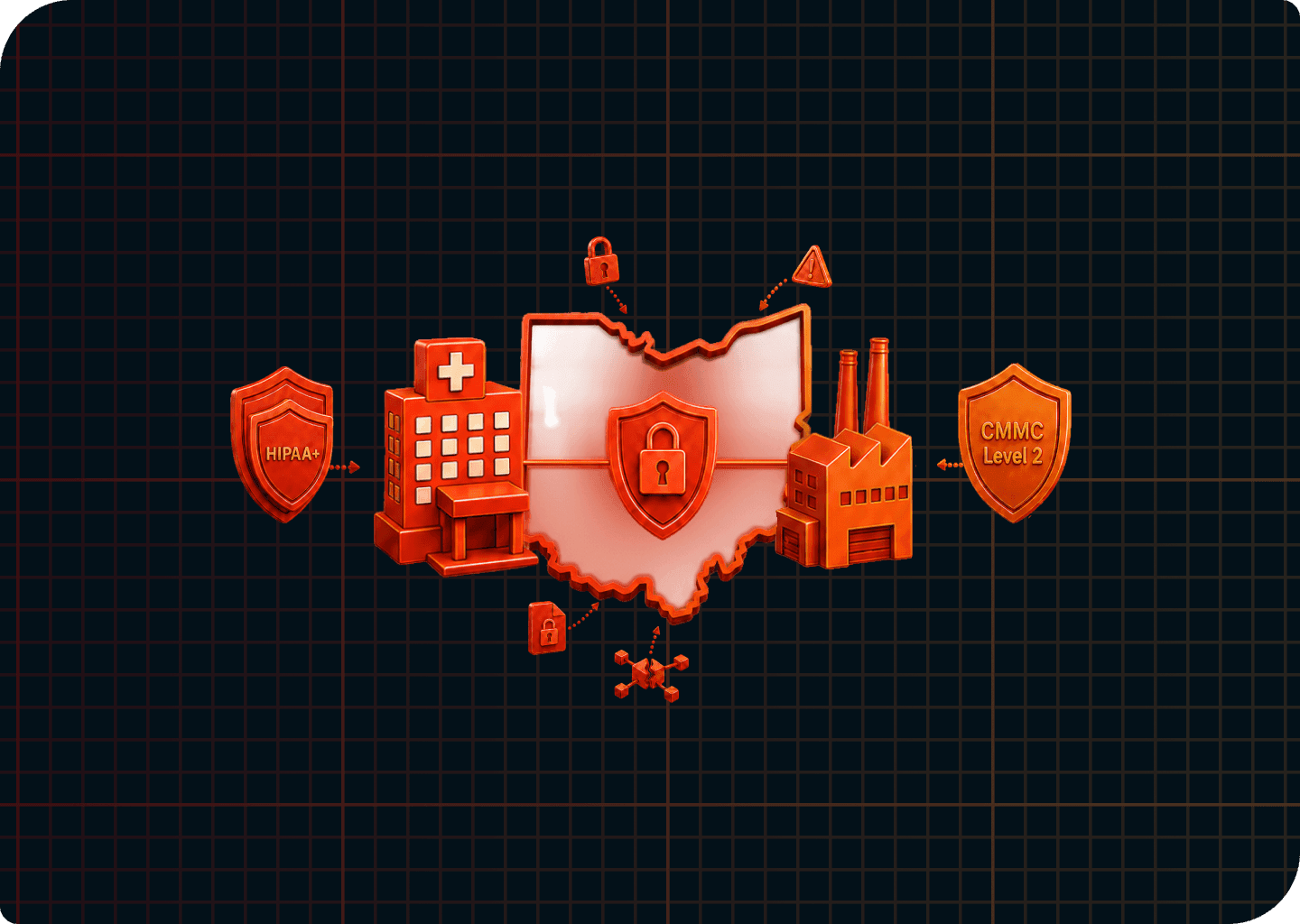
Ohio is one of those few states in the US that has made as much progress in healthcare as it has in manufacturing.
As of December 2025, the Ohio Hospital Association represents 252 hospitals and 17 health systems across the state. This includes long-term acute care facilities, psychiatric and rehabilitation specialty hospitals, critical access hospitals and children’s hospitals.
Understandably, the Ohio healthcare network is huge. But the size of the Ohio manufacturing sector may have it beat.
The Ohio Manufacturer’s Association’s 2025 report states that the sector is responsible for 16.5% of Ohio’s GDP, ranking fifth in the nation’s overall manufacturing GDP.
That same report also says Ohio had around 13,307 manufacturing units, employing more than 800,000 workers. Ohio’s manufacturing sector is quite dense, which sometimes brings cybersecurity challenges for Ohio SMBs.
The worst threat comes from ransomware attacks. And they do not discriminate between sectors.
In January 2025, Ohio became one of the worst-affected states for healthcare data breaches. The state faced 18 breaches, 17 of which were related to the same HCF Management incident.
Bridewell ranks Ohio as the 8th most affected US state for healthcare data breaches between 2023 and 2026.
With the average cost of a manufacturing data breach reaching $5.56 million, according to IBM’s COBD report 2024, Ohio’s defense industrial corridor faces significant risk of exposure.
In light of the recent rise of cyberattacks, Ohio is trying to bolster its cybersecurity defenses with its own state laws beyond the federal regulations of HIPAA and CMMC.
This guide maps the full compliance landscape for both sectors, explains how Ohio’s state law strengthens federal baselines, and provides the steps your organization needs to build a defensible program.
How Does Ohio Strengthen HIPAA With Its State Laws?
The Health Insurance Portability and Accountability Act of 1996 (HIPAA) is the federal framework that governs how covered entities and their business associates handle PHI. For Ohio healthcare organizations, Ohio’s law extends beyond the federal baseline of HIPAA compliance.
The state does not have a separate comprehensive healthcare privacy statute, but Ohio adds specific obligations and restrictions that sit on top of HIPAA. In several cases, it goes further than the scope of HIPAA-only compliance programs.
1. Ohio Revised Code §1349.19: State Breach Notification
Under Ohio Revised Code §1349.19, any person or business that owns or licenses computerized personal information about Ohio residents must notify affected individuals no later than 45 days after discovering a breach. This is a shorter window than HIPAA’s 60-day outer limit.
And unlike HIPAA’s Breach Notification Rule, business associates are not exempt from this statute. A BA that experiences a breach faces a direct 45-day notification obligation that runs independently of its HIPAA reporting chain, and missing it invites prosecution by the Ohio AG.
2. Ohio Code §3701.243: HIV/AIDS Disclosure Rules
Ohio imposes separate and stricter rules on the disclosure of HIV-related information than HIPAA’s general Privacy Rule permits. Some disclosures are mandated for public health reporting purposes, while others require the written authorization of the individual.
A general HIPAA authorization is not sufficient to authorize the release of HIV test results or diagnoses under Ohio law.
3. Ohio Code §5119.27: Substance Use Disorder Privacy
Ohio Code §5119.27 provides privacy protections for substance use disorder patient records that parallel 42 CFR Part 2, the federal regulation governing confidentiality of addiction treatment information.
42 CFR Part 2 compliance is not currently covered by the HIPAA Privacy Rule. For behavioral health organizations, community mental health centers, and any provider treating patients for substance use disorders, §5119.27 creates a parallel compliance obligation that HIPAA alone does not satisfy.
4. Ohio Revised Code §2317.02: Physician-Patient Privilege
Ohio’s physician-patient privilege statute prohibits physicians and certain mental health professionals from testifying or producing patient documentation to be used as evidence in court proceedings. This prohibition overrides HIPAA’s permissions where a covered entity would be allowed to comply with a grand jury subpoena.
However, Ohio’s law puts more restriction, meaning organizations that rely solely on HIPAA’s legal process provisions to guide their disclosure decisions can find themselves on the wrong side of a judicial ruling.
5. Ohio Revised Code Chapter 3965: Cybersecurity Requirements for Insurance Companies
Chapter 3965 establishes cybersecurity program requirements for insurance companies operating in Ohio. This applies to health plans, managed care plans, and insurance carriers, but not the healthcare providers directly.
Security program documentation, risk assessment, and incident response requirements under Chapter 3965 are substantively similar to HIPAA’s Security Rule, but the enforcement and regulatory bodies are different.
Together, Ohio’s state-level healthcare framework creates a compliance environment that is meaningfully stricter than HIPAA in specific areas such as breach notification timelines, substance use disorder records, HIV disclosures, legal process privilege, and insurance cybersecurity obligations.
Any IT or compliance program built solely around federal HIPAA requirements will have gaps in Ohio, and those gaps are where the AG and civil plaintiffs focus on.
How Does Ohio Regulate Its Manufacturing Sector Beyond CMMC?
The DoW uses the Cybersecurity Maturity Model Certification framework to protect Controlled Unclassified Information across the defense industrial sector.
For most Ohio manufacturers, including aerospace suppliers in Dayton, precision machining operations in Cleveland, and defense-adjacent manufacturers in the Columbus corridor, CMMC Level 2 compliance is the target.
Level 2 requires implementation of all 110 security controls from NIST SP 800-171 Revision 2, covering 14 practice domains. The certification is issued by a Certified Third-Party Assessment Organization (C3PAO) and has become a requirement for manufacturers looking to get defense contracts.
But CMMC is just a contractual compliance obligation. Ohio manufacturing organizations carry additional state-level requirements that run alongside it.
1. Ohio Data Protection Act (SB 220): Cybersecurity Safe Harbor
Enacted in 2018, Ohio’s Data Protection Act offers an affirmative legal defense against data breach lawsuits. These are businesses that create, maintain, and comply with a written cybersecurity program that reasonably conforms to one of several recognized industry frameworks.
The qualifying frameworks include the NIST Cybersecurity Framework, FedRAMP, CIS Critical Security Controls, and the ISO 27000 family. For manufacturers already working toward CMMC Level 2 using NIST SP 800-171 as their control set, the safe harbor automatically provides them with legal security.
2. Ohio Revised Code §1349.19: State Breach Notification
The same 45-day breach notification requirement that applies to healthcare organizations applies to Ohio manufacturers. Any manufacturer that owns or licenses computerized personal information about Ohio residents must notify affected individuals within 45 days of discovering a breach.
The data type includes employee records, customer data, supplier contacts, and any PII stored in ERP, HR, or CRM systems.
The compliance picture for Ohio manufacturing sector is therefore layered.
CMMC for DoD contract eligibility, Ohio Data Protection Act for breach litigation safe harbor, and §1349.19 for state notification obligations. These three frameworks operate independently but respond to the same event of a data breach.
What Should Businesses in Ohio Prioritize When These Frameworks Overlap?
Many Ohio organizations operate at the intersection of both sectors.
A medical device manufacturer may be simultaneously a healthcare business associate and a DoW subcontractor. A healthtech vendor supplying software to hospital systems may also hold defense contracts. For organizations caught in both compliance environments, the question of prioritizing which framework arises.
The answer is not to split resources equally between both frameworks and run two parallel compliance programs. That approach doubles overhead, creates documentation inconsistency, and typically results in neither program being done well.
The right approach is to sequence according to enforcement risk and build one security model that satisfies both frameworks from a single evidence base.
1. Sequence by what is more important for your organization
OCR for HIPAA violation does not require a complaint to initiate. If your organization handles PHI and your last Security Risk Analysis is more than 12 months old, that is your highest-urgency remediation item regardless of your manufacturing compliance obligations.
CMMC enforcement comes later. If your DoW contracts are up for renewal, or if prime contractors are already sending compliance attestation requirements, CMMC readiness is a must. A lost contract because of non-compliance will impact your financial bottom line.
2. Stack frameworks where controls overlap
The controls of HIPAA Security Rule and NIST SP 800-171 overlap across risk analysis, access management, audit logging, incident response, and workforce training. An organization that builds a rigorous HIPAA compliance program is completing a meaningful portion of its NIST 800-171 work simultaneously.
3. Treat compliance as a necessity but not as your main cybersecurity program
Let’s be honest: neither HIPAA nor CMMC is a security program. They are compliance frameworks that ask you to document, quantify the risks, and demands accountability.
However, actual security programs that require manual VAPT, continuous monitoring, incident response exercising, and third-party risk management need to be implemented aside from adhering to the compliance frameworks.
How Can Ohio Healthcare Orgs Meet Compliance?
For HIPAA compliance, Ohio organizations must follow the steps below to cover both federal and state obligations:
- Conduct a current Security Risk Analysis: This is the single most important document in an OCR investigation. It must cover all systems that create, receive, maintain, or transmit ePHI, including cloud platforms, EHR systems, billing services, and any third-party tools with PHI access.
Conduct it annually, at minimum, and document the process and findings in a format an auditor can review.
- Audit and update all BAAs: Every vendor with potential PHI access requires a signed BAA. Review your vendor list, from billing services and IT managed service providers to cloud storage providers and data analytics vendors.
Under Ohio’s §1349.19, business associates carry independent 45-day notification obligations to the Ohio AG. Your BAA must explicitly address Ohio breach notification timelines, not just HIPAA’s 60-day federal window.
- Implement required technical safeguards: Implementing MFA, role-based access controls, encrypted transmission and storage, and audit logging that captures access events and enables forensic review are a must.
- Train all workforce members with PHI access annually: Training must be documented and attested. New hires must complete training before accessing any PHI-bearing system.
Also include Ohio-specific requirements, such as the sensitiveness of handling substance use disorder records under §5119.27 and HIV/AIDS records under §3701.243 during training of staff.
- Build and test your Incident Response Plan: Define what constitutes a reportable breach under both HIPAA and Ohio §1349.19 and identify the person responsible for the notification.
You can also pre-draft notification templates and run tabletop exercises annually, so your team knows the playbook before an incident requires it.
- Commission a manual penetration test of systems in ePHI scope: An automated vulnerability scan is not a penetration test. A manual VAPT, conducted by an experienced security professional, gives you defensible evidence that your technical safeguards hold under real conditions.
More importantly, it produces documentation that supports both your Security Risk Analysis and any OCR audit.
How Can Ohio Manufacturing Orgs Meet Compliance?
Ohio manufacturing organizations face a strict compliance timeline. The steps below address what needs to be in place before a C3PAO assessment, a contract renewal, or a breach forces the conversation:
- Define your CUI boundary before assessing anything else: Document which systems, processes, and physical locations handle Controlled Unclassified Information.
This boundary definition is the foundation of your System Security Plan and determines your C3PAO assessment scope. A clearly bounded and well-documented CUI environment reduces both compliance cost and assessment complexity.
- Complete a NIST SP 800-171 gap assessment and calculate your SPRS score: Your Supplier Performance Risk System score is visible to DoD contracting officers. A low or negative score can disqualify your organization from bids before a conversation begins.
Map all 110 controls, document implementation status accurately, and submit your score. However, you cannot overstate your implementation as that will be considered fraud.
- Develop your System Security Plan and Plans of Action: The SSP must describe how each of the 110 NIST 800-171 practices is implemented across your environment.
The POA&M will document controls that have not yet been fully implemented, with realistic timelines and milestones. Both documents are required for a C3PAO assessment and must be latest.
- Implement high-weight technical controls: MFA, endpoint detection and response, audit logging, network segmentation, and encrypted storage for CUI are some of the measures you should implement. These are not only NIST 800-171 requirements, but also the controls most likely to be tested in a C3PAO assessment.
- Document your Ohio Data Protection Act compliance alongside CMMC: If your written cybersecurity program reasonably conforms to NIST SP 800-171, you are positioned for SB 220 safe harbor protection.
Ensure the program is explicitly documented as a written cybersecurity program, scoped to the size and nature of your business, and maintained on an ongoing basis.
- Run a pre-assessment mock audit and commission manual penetration testing of in-scope systems: Before engaging a C3PAO, conduct a structured internal review using the CMMC 2.0 Level 2 assessment guide. A manual penetration test of systems within your CUI boundary provides validation of your technical controls and generates documentation that strengthens your security posture before the audit.
How Can KLEAP Help With Compliance Services in Ohio?
KLEAP Cybersecurity is a boutique concierge pentesting and compliance firm built specifically for healthcare and manufacturing SMBs navigating the compliance environments described in this guide.
For organizations looking for compliance services in Ohio that go beyond templated checklists, the concierge model is the defining difference: every engagement is led by a dedicated expert who works directly with your team from kickoff through deliverable. One point of accountability. No handoffs.
For Ohio healthcare organizations, KLEAP builds HIPAA compliance programs tied to actual implemented controls, not policy documents that check boxes. That means Security Risk Analyses scoped to your real environment, BAA reviews that account for Ohio’s §1349.19 obligations, and manual penetration testing of systems in ePHI scope.
For Ohio manufacturing organizations, KLEAP helps defense supply chain SMBs build the documentation, controls, and evidence packages required to pass a CMMC Level 2 C3PAO assessment.
For organizations at the intersection of both sectors, KLEAP builds unified compliance programs that map to both HIPAA and CMMC from a single control framework.
If your organization is navigating cybersecurity Ohio’s regulators now demand, whether that means HIPAA compliance, CMMC readiness, or both, KLEAP delivers the compliance services Ohio healthcare and manufacturing organizations need.