
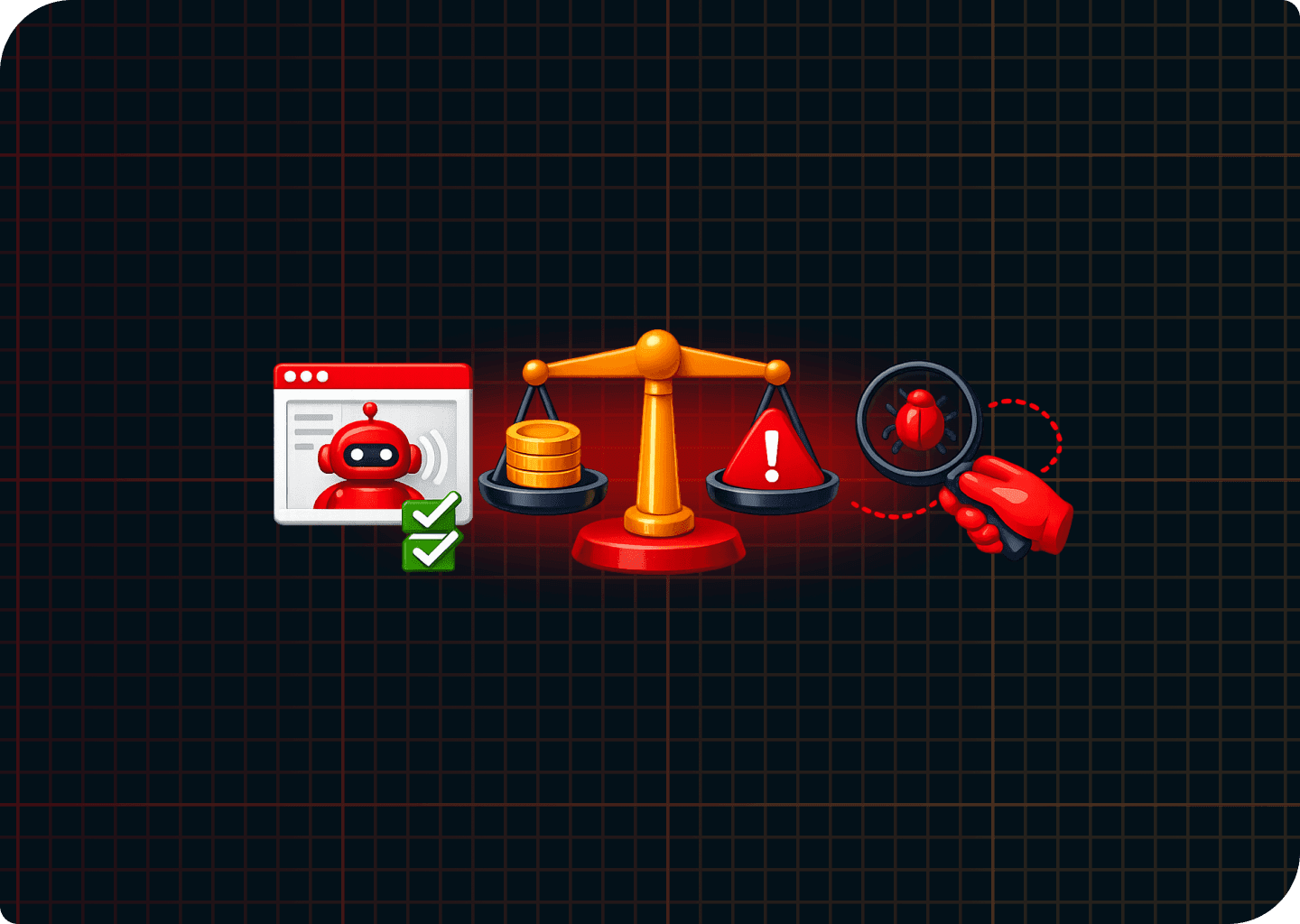
Most IT directors or Security Managers/Directors don’t choose automated web app pentesting because they think it’s better. They choose it because it’s cheaper.
And on paper, it makes a lot of business sense. An automated scan runs for a few thousand dollars. A manual penetration test starts at five to ten times that.
When you’re managing a security budget that already feels stretched and that has to be justified, the math seems obvious.
But here’s what the math doesn’t show you: what each option gives you in detail, what the automation misses, and what those gaps could really mean for your organization when something goes wrong.
A 2025 industry analysis found that the vulnerabilities discovered through manual testing increased by nearly 2,000% compared to automated detection – particularly in APIs, cloud configurations, and chained exploits where multiple low-severity issues combine into a high-impact attack path.
And these are typically the kind of flaws that require a human being to think through context, intent, and consequence. The nuances which usually an automation tool doesn’t offer.
This isn’t a blog arguing that automated pentesting is useless. It’s not. Automated pentesting tools have a real and important role in a security program.
But if you’re someone making a purchasing decision between these two options – especially in a regulated industry like healthcare or manufacturing where your pentesting reports end up in front of auditors – you need to understand what you’re buying behind at each price point and how each of these options make a difference to your security posture.
This guide breaks it down: what automated pentesting tools cover, what manual penetration testing covers, what lies behind the pricing, which tools exist in the market, and the specific risk elements that get ignored when budget drives the decision instead of scope.
What Does An Automated Web App Pentesting Typically Cover?
Automated web application pentesting – or more accurately, automated vulnerability scanning with some exploit validation – uses software tools to crawl your application, probe its endpoints, and check for known vulnerabilities against established databases.
When you run an automated scan against a web application, the tool is typically doing some combination of the following: crawling every reachable page and endpoint to map the application’s surface, testing input fields for common injection patterns like SQL injection and cross-site scripting, checking server configurations for issues like missing security headers, permissive CORS policies, or outdated TLS versions, identifying known CVEs in the software stack based on version fingerprinting, testing for default or weak credentials, and flagging basic misconfigurations in authentication and session handling.
The better automated platforms go a step further.
Tools like Invicti use what they call proof-based scanning, which means the tool doesn’t just flag a potential SQL injection – it attempts to confirm exploitability and provides evidence. This reduces false positives significantly compared to older-generation scanners.
Pentera and Horizon3.ai’s NodeZero take a different approach entirely, operating as autonomous penetration testing platforms that simulate full attack chains across networks – credential harvesting, lateral movement, privilege escalation – without human involvement.
These tools are genuinely useful. They are fast, consistent, and scalable.
An automated scan that takes hours to complete across an entire application would take a manual tester days.
And they produce identical, reproducible results every time – which matters when you need to demonstrate to an auditor that the same methodology was applied across twenty applications, not just the three your budget allowed a human to test.
Here’s where the limits show up.
Automated pentesting tools work by matching patterns. They test for things that are already known – documented vulnerabilities, common misconfigurations, published attack signatures. They’re excellent at finding what’s been seen before. They are fundamentally unable to find things outside of what is previously known.
A business logic flaw – where the application behaves exactly as coded but the logic itself is exploitable – produces no signature, no pattern, and no CVE to match against.
When a user can skip a payment step by replaying an API call out of sequence, or access another user’s records by modifying a parameter the application trusts but shouldn’t, or escalate their role by manipulating a field the developer assumed would never be touched – these are the vulnerabilities automated tools do not catch.
Not because the tools are poorly built, but because identifying these flaws requires understanding what the application is supposed to do, and then figuring out how to make it do something it shouldn’t.
No scanner in the market can do that reliably today.
What Does A Manual Web App Pentesting Cover?
The term “manual” can be misleading.
A manual penetration test doesn’t mean someone is sitting there typing every request by hand. Manual testers use automated pentesting tools constantly – Burp Suite for intercepting and modifying traffic, Nmap for network reconnaissance, Nuclei for scanning known CVEs.
The difference is that a human is directing the process, interpreting the results, and making decisions about what to test next based on what they’re finding in real time.
That distinction matters more than most people realize.
A manual web app pentest typically begins with scoping and reconnaissance.
The tester studies how the application works – its user roles, its workflows, its integrations, its authentication flows.
They map out how data moves through the system, where sensitive information is handled, and which features carry the most risk.
This phase alone produces insight that no automated tool attempts, because it requires understanding the application as a business system, not just a collection of endpoints.
From there, the tester moves into authentication and session testing.
They’re not just checking whether the login page is vulnerable to brute force. They’re examining how tokens are generated, whether session tokens survive after logout or password change, whether a token issued to one user role can be manipulated to access another role’s functionality, and whether the OAuth or JWT implementation has flaws like algorithm confusion or missing claim validation.
They test these by actually intercepting tokens, modifying them, replaying them, and observing how the application responds – an adversarial process that requires judgment at every step.
Authorization testing is where manual penetration testing earns most of its value.
This is the BOLA and IDOR territory that sits at number one on the OWASP API Security Top 10, and it’s the category of vulnerability most commonly missed by automated pentesting tools.
The tester creates or is given multiple accounts with different permission levels – a regular user, an admin, perhaps a read-only role.
Then they systematically attempt to cross boundaries.
Can User A access User B’s records by changing an ID in the request? Can a standard user hit an admin endpoint and get a response? Can a read-only account make a write call that the application accepts?
These tests require the tester to understand the application’s intended access model and then deliberately violate it.
An automated scanner doesn’t know what “intended” means. It sees endpoints and parameters.
A human tester sees a scheduling system where a nurse should only view her own patients and then tests whether changing a patient ID in the URL pulls up someone else’s chart.
Then there’s business logic testing – the aspect that is essentially invisible to automation.
This includes testing whether multi-step workflows can be executed out of order, whether pricing or discount logic can be manipulated on the client side, whether file upload restrictions can be bypassed, whether race conditions allow a single-use action to be triggered multiple times, and whether the application handles edge cases in ways the developers didn’t anticipate.
Every application has its own business logic, which means every business logic test is custom. There’s no database of known business logic vulnerabilities to scan against.
Input validation and injection testing in a manual pentest goes beyond what the automated pentesting tools attempt.
While a scanner will throw standard SQL injection payloads at every input field it can find, a manual tester adjusts their approach based on the technology stack, the error messages they observe, and the behavior of the application.
They test for second-order injection – where a payload is stored in one location and triggered in another.
They test for blind injection using time-based or boolean-based techniques when the application doesn’t return visible errors.
They chain injection with other flaws – for example, using a server-side request forgery vulnerability to reach an internal service, then leveraging that access to extract data from a database that was never meant to be internet-facing.
Chaining is the operative word.
The most dangerous real-world attacks almost never rely on a single vulnerability.
They’d typically combine a low-severity information disclosure with probably a medium-severity misconfiguration and a logic flaw to create greater impact.
Manual testers, unlike automated testing tools, think in chains – because that’s how attackers think.
Finally, the manual tester validates everything.
Every finding in the report includes proof-of-concept evidence – the exact request, the exact response, the exact steps to reproduce.
There are no “potential” or “possible” findings.
If it’s in the report, it was exploited. This is what separates a penetration testing report from a vulnerability scan output, and it’s what auditors and regulators are looking for when they ask to see your pentesting reports.
Where does the price come from?
The assumption that automated pentesting is always cheaper and manual is always expensive isn’t accurate. Pricing in both categories depends on the tool or provider, the penetration testing scope, and the complexity of the application being tested.
On the automated side, the range is enormous.
ZAP By Checkmarx is free. Burp Suite Pro costs $475/year. Nessus runs $4,390–$6,390/year. At the enterprise end, autonomous platforms like Pentera – which simulate full kill-chain attacks across networks without human involvement – start around $50,000/year.
The word “automated” covers everything from a free open-source scanner to a six-figure enterprise platform.
Manual web app pentesting has a similarly wide range.
A focused manual pentest on a simple application with a limited scope can cost $1,000–$4,000.
A moderately complex web app with multiple user roles and API integrations typically runs $5,000–$15,000.
Deep-scope engagements for complex applications with extensive API surfaces, microservices architectures, or healthcare and financial workflows can reach $15,000–$25,000 or more – particularly when pentesting reports need to map findings to compliance frameworks like HIPAA, SOC 2, or ISO 27001 for audit evidence.
As a rough benchmark, manual web app pentesting for a comparable scope tends to run about 1.5x the cost of automated testing.
That premium reflects the human expertise involved – the ability to test business logic, chain vulnerabilities, validate exploitability, and produce proof-of-concept evidence for every finding.
But something which actually drives bad purchasing decisions: not the price difference.
It’s treating automated and manual as interchangeable options at different price points, when they’re fundamentally different in what they cover.
An automated scan – whether it costs $500 or $50,000 – gives you broad visibility into known, pattern-matchable vulnerabilities.
A manual penetration testing engagement – whether it costs $3,000 or $20,000 – gives you validated, human-tested coverage of the business logic flaws, authorization bypasses, and chained attack paths that automation cannot reach.
When IT directors choose automated over manual purely because the number is lower for a given scope, they end up with excellent coverage of medium-severity known issues and zero coverage of the high-severity unknowns.
And even when the market has a lot of information about this, very few vendors would put it out in detail what the automated pentesting tools will not do for you.
Why KLEAP focuses only on Manual Web App Pentesting?
We believe in manual penetration testing at KLEAP. Nothing less.
Every web app pentesting engagement we commit to is led by a dedicated security expert who scopes your application, understands your user roles and workflows, and tests with the same mindset an attacker would bring. We validate every finding with proof-of-concept evidence.
For healthcare and manufacturing clients, we map findings directly to the compliance frameworks your auditors expect – HIPAA, SOC 2, ISO 27001 – so your pentesting reports serve as remediation roadmaps and audit evidence in one document.
If you want to explore how manual pentesting can give you a better picture of your security posture. Or if you’re looking for a partner to guide you through all the security jargon.
And if you’re into healthcare or manufacturing, reach out to us.