
Stalled cybersecurity compliance initiatives can be devastating in the healthcare and manufacturing industries. Learn why vendor choice matters and how to run compliance services as a workflow for HIPAA, SOC 2, ISO 27001, and NIST-aligned programs.
Cybersecurity compliance looks manageable on paper, right up to the moment evidence collection starts.
That is when teams face the real problems: ownership remains unclear, data sits fragmented across tools, and remediation work gets stretched.
This gap between patching security issues and documenting the process is where most of the compliance exercises falter.
In healthcare, the HIPAA Journal Annual Survey of 2024 showed only 21% of respondents declare complete confidence in their ability to prove full compliance in an OCR audit; in the DoD supply chain, only 4% say they’re completely ready for CMMC certification, as shown in a study released by CyberSheath and Merrill Research.
Security teams often discount or realize too late the importance of continuous provenance in compliance.
This is further exacerbated by cybersecurity compliance vendors/service providers who also fail to inform and implement this key aspect.
Identifying and solving the security gaps in your operations is one half of the compliance process. The other is having a system that records and replicates the measures you took during it.
This is the only way compliance stops being an annual event of frantic evidence accounting for your security team.
So, what does it really mean to be audit-ready?
- Your controls are mapped to systems and people.
- The evidence is indexed per control, current, and retrievable.
- Remediation gets tracked to closure with acceptance criteria.
- You have validation notes that prove fixes worked.
- All exceptions are documented with a rationale and compensating controls.
This gets even more complex when you’re trying to run compliance in sensitive industries like healthcare and manufacturing.
Healthcare cybersecurity compliance gets more intense because the HIPAA Security Rule guidance is built around implementing administrative, physical, and technical safeguards to protect ePHI, and the guidance is updated over time.
Similarly, for manufacturing cybersecurity compliance, you get mixed environments, legacy apps, vendor sprawl, and thin internal teams.
In such industries, you can’t just take security compliance for granted. You need a comprehensive system for repeatable execution.
To fix these compliance struggles and the vendor blind spot, KLEAP brings you the concierge model for compliance services.
Our team converts your compliance requirements into a roadmap with owners, cadence, and an evidence engine that helps your org remain updated across HIPAA compliance, ISO 27001 compliance, NIST compliance, and SOC 2 compliance efforts.
Why Cybersecurity Compliance Breaks After the Gap Assessment
The cybersecurity compliance landscape is always in flux.
For instance, in healthcare cybersecurity compliance, the HHS has been updating guidance and even proposed substantial HIPAA Security Rule changes in recent years, which increase the need for always-current evidence.
Security compliance initiatives fail because evidence is handled like a one-time collection drive. Here’s what breaks repeatedly:
Teams collect evidence in fragments. It lives across drives, email threads, and tool exports. Audit-ready compliance needs every control to have a known evidence owner and a known evidence location. ISO 27001 leans heavily on “documented information” for exactly this reason.
Most security compliance initiatives stop once there’s a fix. But auditors care about ongoing proof that controls exist and work as intended.
SOC 2, for example, is an examination report about controls relevant to the Trust Services Criteria, which makes operating evidence central to the outcome.
Without proper cadence, compliance becomes a series of last-minute sprints to collect evidence. This is also where NIST compliance language becomes practical. NIST CSF 2.0 explicitly talks about using organizational profiles to assess gaps, prioritize actions, and communicate outcomes.
The Compliance Vendor Issues You Keep Running Into
Compliance services fall apart when vendors drown you in a lot of useless paperwork, but without enough proof to substantiate it.
In OCR’s HIPAA audit findings, organizations often submitted template policy manuals with no evidence of entity-specific review or implementation, or showed vendor security activities without the risk analysis that justified them.
Other recurring gaps include evidence chaos and credibility risk. Here are the most common compliance pain points we’ve seen clients run into with other security compliance vendors.
- They deliver generic policy manuals when auditors look for entity-specific documentation and proof of implementation.
- They do the security work (scans, tools, and checklists) but cannot show the risk analysis that justified those activities.
- Some vendors focus on minor document issues while missing control effectiveness and real risk.
- Security risks get identified, but remediation under-delivers on technical safeguards and isn’t backed by documented evidence.
Why does the right compliance services partner help?
We see teams deliberating over the “right” framework. They all matter. But in execution, delivery becomes an issue, and most likely it’s a vendor problem.
A good vendor turns requirements into a working, repeatable operating model, and that’s why vendor choice matters more than methodology when you are availing cybersecurity compliance services.
For instance, in CMMC ecosystems, even the assessment layer can be scrutinized. A DoD OIG audit flagged weaknesses in how some third-party assessment organizations were authorized, which raises diligence requirements for clients choosing who to trust for certification work.
SOC 2 is literally an examination report about controls relevant to the Trust Services Criteria. In plain terms, you are being evaluated on whether controls exist and whether they operate as described. That makes proof of execution the central piece.
HIPAA is similar in spirit. HHS guidance is blunt about what a risk analysis should output: documented risk levels and corrective actions. Again, not theory, but documented execution.
NIST CSF 2.0 is also explicit about turning cybersecurity into something you can assess, prioritize, and communicate using Organizational Profiles.
All of this is more about creating a prioritization and communication workflow, not merely an exercise that checks some boxes.
This is where KLEAP’s concierge model for compliance services makes a difference.
We Give You A Guided Security Compliance Roadmap
Trying to get compliant by collecting documents has now become inefficient.
A more effective way to be audit-ready is when you run a roadmap that connects four things: scope, ownership, evidence, and validation.
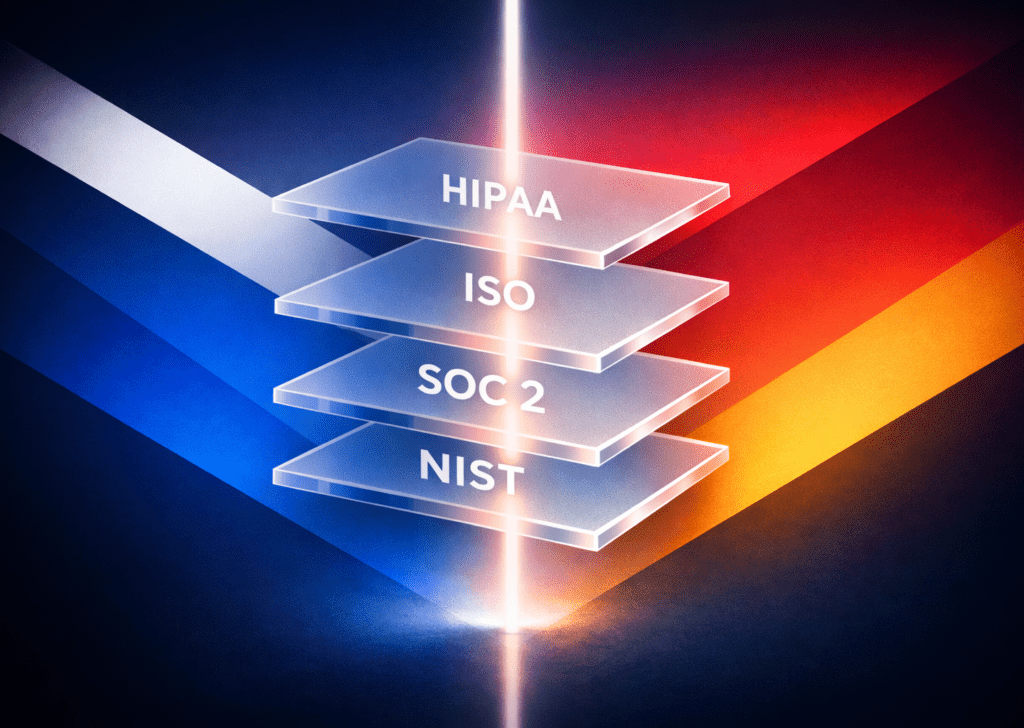
Below is a roadmap you can actually run, whether your target is SOC 2, ISO 27001, HIPAA, NIST compliance, or any other framework.
Step 1: Define what your scope is.
Decisions to lock
- Target: SOC 2, ISO 27001, HIPAA, NIST-aligned program
- Systems: which apps, cloud accounts, endpoints, vendors, pipelines
- Timeline: audit date, observation window, and what “operating” means for your controls
Output
- One-page scope statement
- System inventory
This matters more than teams admit in cybersecurity compliance, where environments sprawl across sites and vendor stacks, and a blanket “include everything” workaround isn’t optimal.
Step 2: Convert the gap assessment into a control-to-evidence map.
Output you want
Control → system → owner → evidence → status
For instance, for ISO 27001 compliance, documented information discipline is core: controlled, retrievable, and tied to what auditors need to verify.
Step 3: Turn remediation into a backlog with acceptance criteria
Every remediation item needs
- an owner
- a due date
- acceptance criteria (what proof counts as “done”)
- dependencies
- a validation step
For HIPAA compliance, HHS guidance expects documented risk levels plus a list of corrective actions.
Step 4: Build for continual documentation that can be automated.
All evidence needs a home, an index, and a cadence.
- Single evidence repository
- Evidence index per control (links, not file hunts)
- Naming/version rules
- Weekly or bi-weekly review cadence
Step 5: Validate and package for the audit.
For SOC 2 compliance, the AICPA frames SOC 2 as a report on controls relevant to the Trust Services Criteria and intended to meet the needs of users who require assurance about those controls. That means your roadmap must produce operational evidence and validation.
Outputs
- Retest notes/validation checklist
- Exceptions register (what, why, compensating control, review date)
- Final pack: control map + evidence index + decision log + validation proofs
Simplify Cybersecurity Compliance with KLEAP
A gap assessment tells you where your security compliance stands. Audit-ready means you can prove how controls operate, with evidence that is mapped, indexed, and current.
KLEAP’s concierge model exists for teams that don’t have the bandwidth to figure out cybersecurity compliance or are now frustrated with vendor inefficiencies.
We exist for teams who are looking for someone to manage their security and compliance end-to-end.
We help you scope fast, translate requirements into a remediation checklist with owners, keep an evidence engine alive through a weekly cadence, and package outcomes into an audit-ready set of artifacts.